
1. Industry Background
In modern distribution networks, the ring main unit (RMU) plays a critical role in power distribution, network interconnection, and load transfer within 10kV systems. With the rapid expansion of urban power grids, the number of RMUs continues to grow, often operating under high load conditions in enclosed environments.
Over time, insulation degradation, loose connections, and environmental factors can lead to partial discharge, abnormal temperature rise, and even unexpected outages. These issues are often difficult to detect at an early stage.
Traditional maintenance methods rely heavily on periodic manual inspections, which are limited by long intervals and lack real-time visibility. Early-stage faults—especially partial discharge and contact overheating—typically show no obvious external signs, making proactive detection a challenge.
2. System Architecture
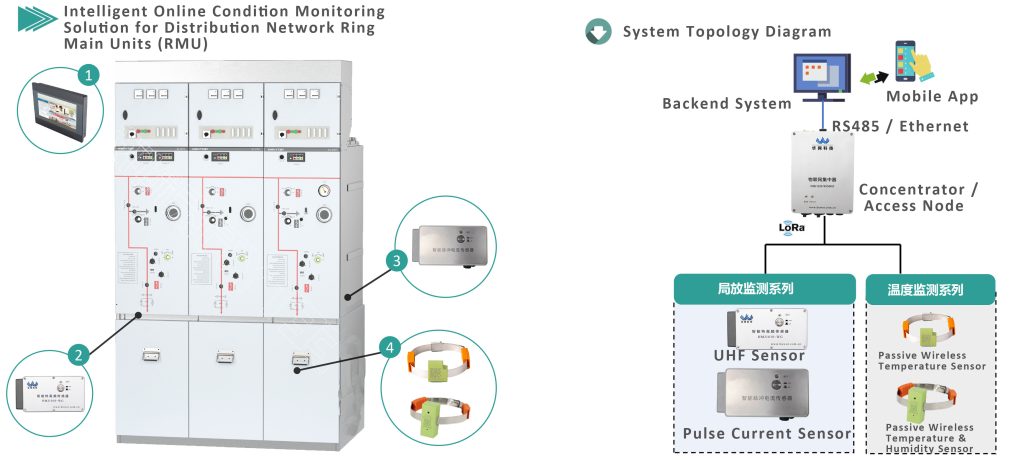
The ring main unit online monitoring system adopts a multi-source sensing architecture, integrating:
- Partial discharge monitoring
- Temperature monitoring
- Environmental monitoring
The system consists of:
- Partial discharge sensors (UHF + HFCT)
- Wireless temperature sensors
- Temperature and humidity sensors
- Edge data acquisition unit
- Central monitoring platform
By combining edge computing with cloud-based analytics, the system forms a complete loop of data acquisition, analysis, and remote operation.
3. Core Monitoring Functions
3.1 Partial Discharge Monitoring for RMU
The system utilizes both UHF (Ultra High Frequency) sensors and HFCT (High-Frequency Current Transformer) sensors to detect partial discharge signals from different propagation paths.
- UHF sensors capture electromagnetic emissions within the cabinet
- HFCT sensors detect conducted pulse currents along grounding paths
This dual-detection approach improves sensitivity and noise immunity, enabling early identification of insulation defects, surface discharge, and poor contact conditions.
3.2 Wireless Temperature Monitoring
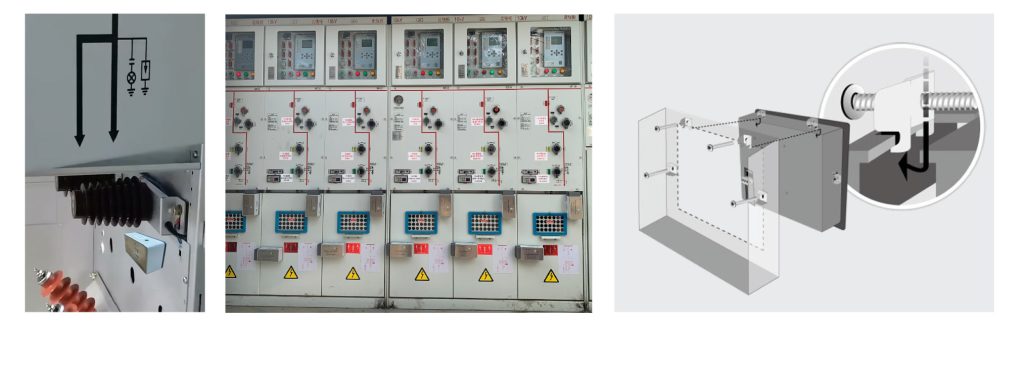
Wireless temperature sensors are installed at key points such as cable joints, busbar connections, and switch contacts.
Powered by inductive energy harvesting, these sensors require no external wiring and support long-term stable operation. Continuous temperature tracking helps identify:
- Loose connections
- Increased contact resistance
- Overload conditions
Trend analysis allows early warning before critical overheating occurs.
3.3 Environmental Monitoring
Temperature and humidity inside RMUs significantly affect insulation performance.
The system monitors environmental conditions in real time to detect:
- Moisture accumulation
- Condensation risks
- Accelerated insulation aging
By correlating environmental data with partial discharge and temperature trends, the system enhances diagnostic accuracy.
4. Intelligent Analysis and Early Warning
The system performs preliminary data processing at the edge level, reducing unnecessary data transmission and improving response efficiency.
The central platform applies advanced analytics, including:
- Partial discharge pattern recognition
- Temperature trend evaluation
- Multi-parameter correlation analysis
- Abnormal condition detection
When thresholds are exceeded or abnormal trends are detected, alerts are triggered automatically via platform notifications or messaging systems.
5. Key Benefits
Deploying a ring main unit monitoring system provides:
- Early detection of insulation faults
- Reduced risk of unexpected outages
- Lower maintenance costs through condition-based monitoring
- Improved asset visibility and lifecycle management
It enables a shift from reactive maintenance to predictive maintenance in distribution networks.
6. Applications
The system is suitable for:
- Urban distribution RMUs
- Switchgear systems
- Compact substations
- Industrial power distribution networks
Its modular design allows flexible installation with minimal impact on existing equipment, making it ideal for both new installations and retrofit projects.
7. Conclusion
As distribution networks evolve toward digitalization and intelligent operation, online monitoring of ring main units becomes essential. By integrating partial discharge monitoring, temperature sensing, and environmental analysis, this solution provides a reliable foundation for safer and smarter power system operation.