
Partial Discharge Detector Manufacturer
Protecting your equipment. Powering your future.
-
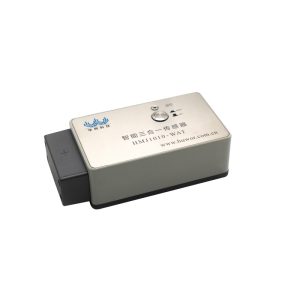
3-in-1 Partial Discharge Sensor – TEV, Ultrasonic & Temperature Humidity Monitoring
Partial Discharge Sensor -
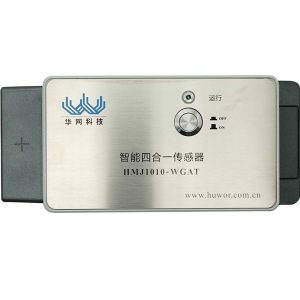
4-in-1 Partial Discharge Monitoring Sensor
Partial Discharge Sensor -
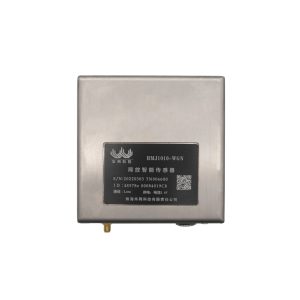
Built-in UHF Partial Discharge Sensor
Partial Discharge Sensor -
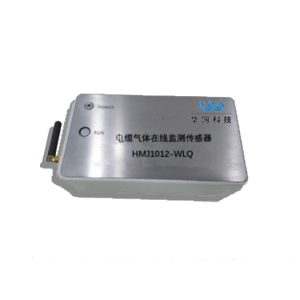
Cable Gas Online Monitoring Sensor
Partial Discharge Sensor -
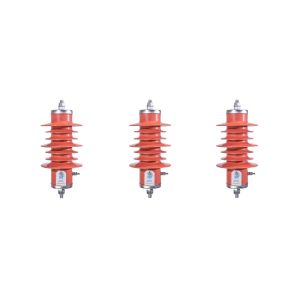
Ceramic Insulator Sensor
Partial Discharge Sensor -
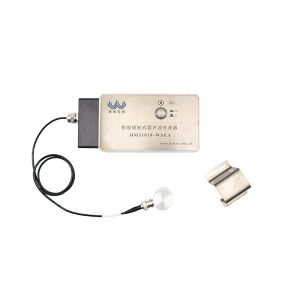
Contact-type Ultrasonic Partial Discharge Sensor
Partial Discharge Sensor
IEC 60270 Verified
All partial discharge detectors and sensors are factory-calibrated and verified for apparent charge measurement accuracy in accordance with IEC 60270.
ISO 9001 Certified Manufacturing
Manufactured under an ISO 9001 certified quality management system, with strict quality control procedures applied on every production line.
100% Factory Tested
Every unit undergoes full functional testing before shipment, covering PD sensitivity, linearity, temperature performance and communication checks.
In-House R&D, 52 Patents
R&D centers in Zhuhai and Xi’an, backed by 52 patents and 63 software copyrights, drive continuous product development.
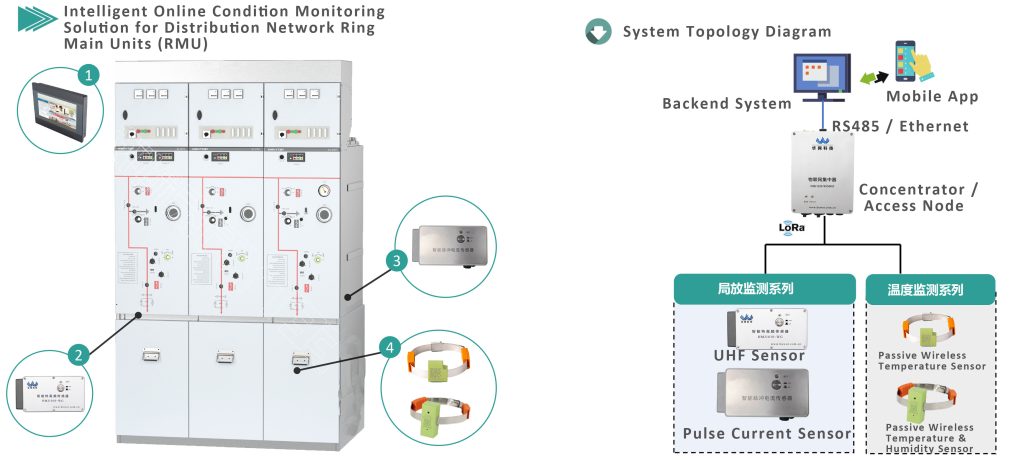
Ring Main Unit Online Monitoring System Solution for Distribution Networks
1. Industry Background In modern distribution networks, the ring main unit (RMU) plays a critical…
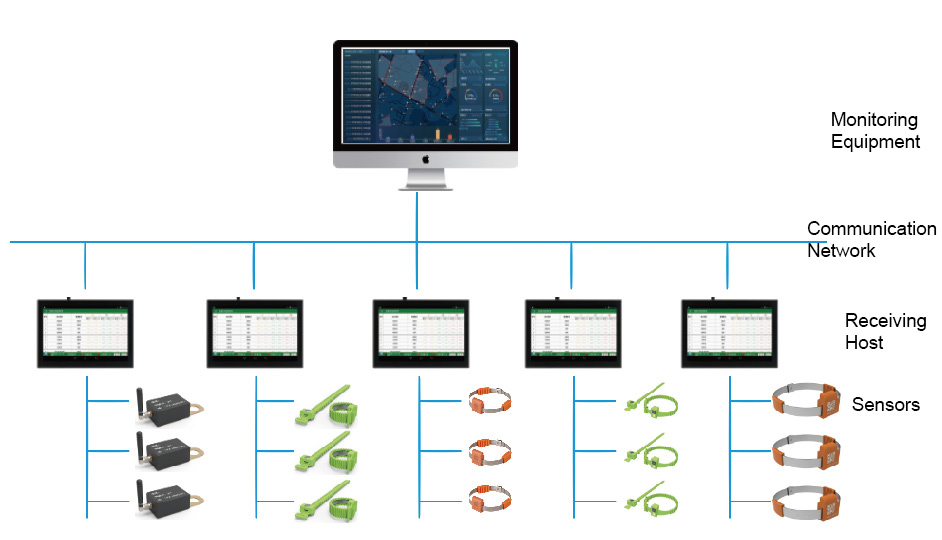
Wireless Temperature Monitoring System
Our wireless temperature monitoring system provides a flexible and reliable solution for various applications, especially…
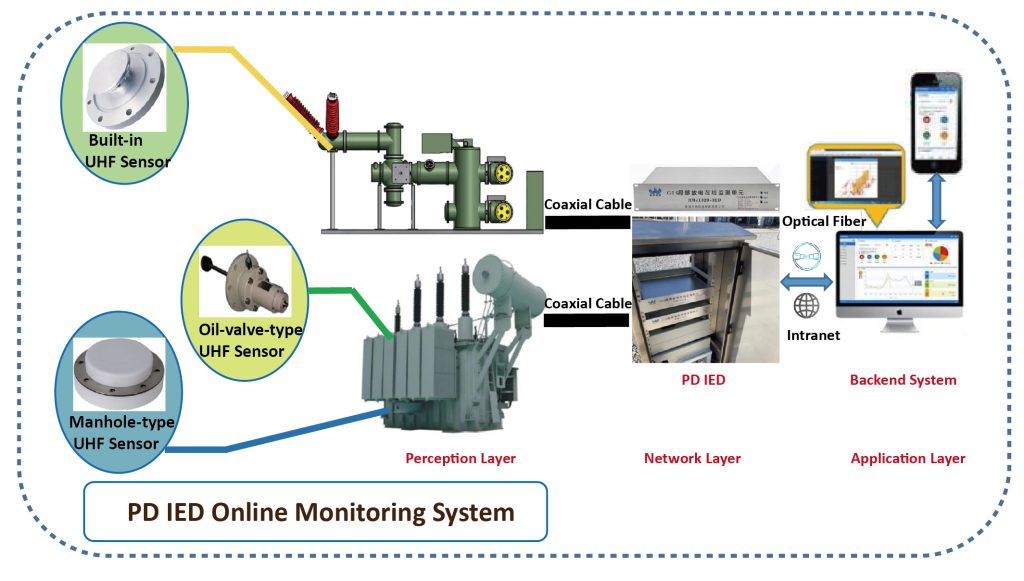
PD IED Online Monitoring System Architecture
System Architecture PD IED Online Monitoring System- Architecture System Functions The PD IED Online Monitoring…
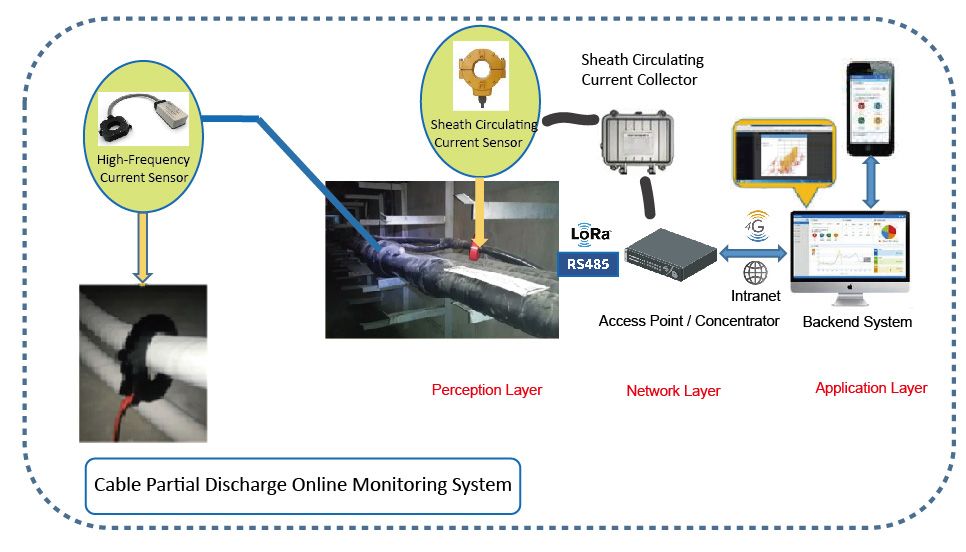
Cable Online Monitoring System
System Architecture & Functions Cable Partial Discharge Online Monitoring System The Cable Online Monitoring System…
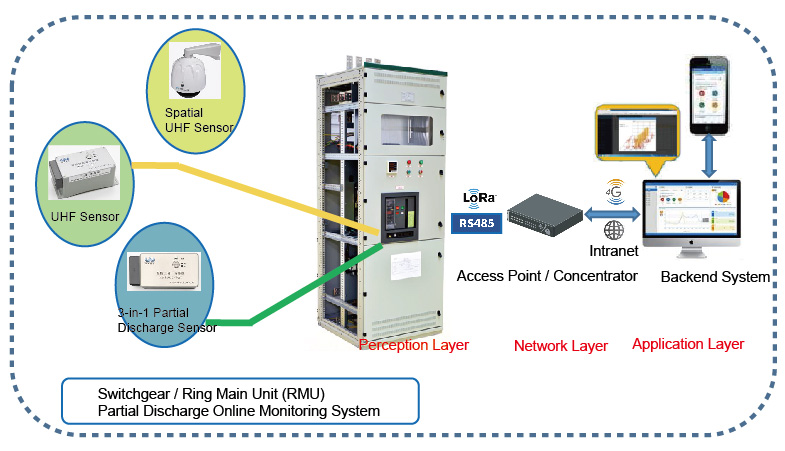
Switchgear Online Monitoring System
System Architecture of Switchgear Online Monitoring The Switchgear Online Monitoring System is designed to provide real-time…
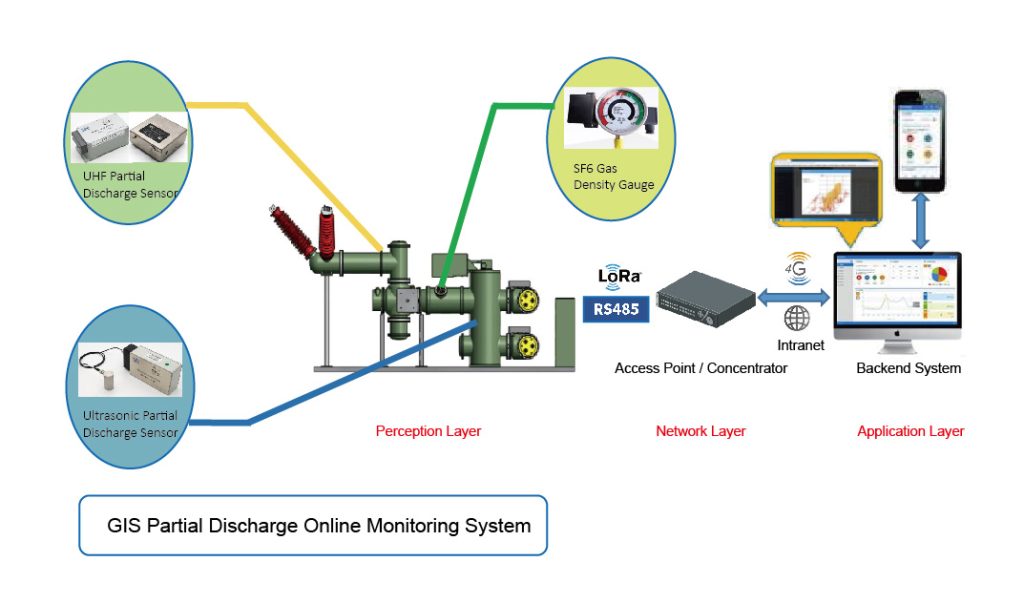
GIS Partial Discharge (PD) Online Monitoring System
GIS Partial Discharge (PD) Online Monitoring System System OverviewThe GIS Partial Discharge (PD) Online Monitoring…
Partial Discharge Monitoring: Top Questions Answered
Straight answers from a PD sensor manufacturer
What is partial discharge and why does it matter for power equipment?
Partial discharge (PD) is a localized electrical breakdown of insulation that does not completely bridge the electrodes. It is a leading indicator of insulation degradation in high-voltage equipment such as GIS, switchgear, transformers and cables. If left undetected, PD can lead to insulation failure, unplanned outages and costly repairs. Standards such as IEC 60270 define how PD is measured. Huawang Technology provides UHF, TEV, ultrasonic and HFCT sensors to detect PD early so maintenance can be planned before failure.
What are the main partial discharge detection methods?
The four main PD detection methods are: UHF sensors that capture electromagnetic pulses from internal discharge, ideal for GIS; TEV sensors that detect surface discharge on switchgear panels; ultrasonic (AA) sensors that pick up acoustic signals; and HFCT sensors for cables and pulse current measurement. Huawang Technology manufactures all four types, including multi-functional sensors combining TEV, ultrasonic and temperature-humidity monitoring in one unit.
How do I choose the right partial discharge sensor?
Sensor selection depends on the equipment type. For GIS, use UHF sensors. For switchgear and RMU panels, TEV combined with ultrasonic (AA) sensors works best. For power cables, HFCT pulse-current sensors are recommended. For comprehensive coverage, a 4-in-1 sensor integrating UHF, TEV, ultrasonic and temperature-humidity monitoring can be installed on switchgear. Huawang Technology offers application engineering support to help select and install the correct configuration.
Can partial discharge monitoring be installed on live equipment without downtime?
Yes. Most Huawang Technology PD sensors support live installation. Surface sensors such as TEV and ultrasonic are non-invasive and can be mounted on energized panels, while UHF sensors can be fitted to GIS drain valves or mounting adapters. Online monitoring systems stream data continuously through LoRa, RS485, 4G or wired networks, providing early warning without interrupting power supply.
Does Huawang Technology support OEM and ODM for partial discharge products?
Yes. Zhuhai Huawang Technology Co., Ltd. is a manufacturer with in-house R&D, offering OEM and ODM services for PD detectors, PD sensors and IoT monitoring products. With R&D centers in Zhuhai and Xi’an, 52 patents, 63 software copyrights and ISO 9001 certified manufacturing, we can customize product specifications, branding and software platforms for distributors and system integrators worldwide.
What is surge arrester leakage current monitoring?
Surge arrester (MOA) leakage current monitoring measures the resistive and total leakage current flowing through an arrester, plus lightning strike counts. Rising resistive current indicates ageing or moisture ingress inside the arrester. Huawang Technology’s wireless leakage current sensors transmit data via LoRa to a gateway, enabling remote health assessment of arresters in substations without manual inspection.