
The backbone of modern power transmission and distribution is the high-voltage (HV) cable network. While robust, these cables are constantly under stress, and their insulation integrity is paramount to grid reliability. A silent, insidious threat known as Partial Discharge (PD) within the cable insulation is the primary precursor to catastrophic failure. Understanding and proactively managing this phenomenon through Partial Discharge Cable testing is not just a maintenance task—it is a strategic imperative for utilities and industrial operators worldwide.
The Threat: Partial Discharge in Cables
Partial Discharge (PD) in a cable refers to a localized dielectric breakdown that does not completely bridge the insulation between the conductor and the sheath. It typically occurs in small voids, cracks, or imperfections within the solid insulation material, such as XLPE (Cross-linked polyethylene) or EPR (Ethylene Propylene Rubber).
The process is cyclical:
- Initiation: High electrical stress concentrates at a defect (e.g., a void, a protrusion, or a contaminated area).
- Discharge: The localized electric field exceeds the dielectric strength of the defect, causing a small, momentary electrical spark.
- Degradation: This discharge releases energy in the form of heat, light, sound, and chemical byproducts (like ozone), which erode the surrounding insulation material.
- Propagation: Over time, the continuous erosion enlarges the defect, leading to more intense PD activity, eventually culminating in a complete insulation breakdown and cable failure.
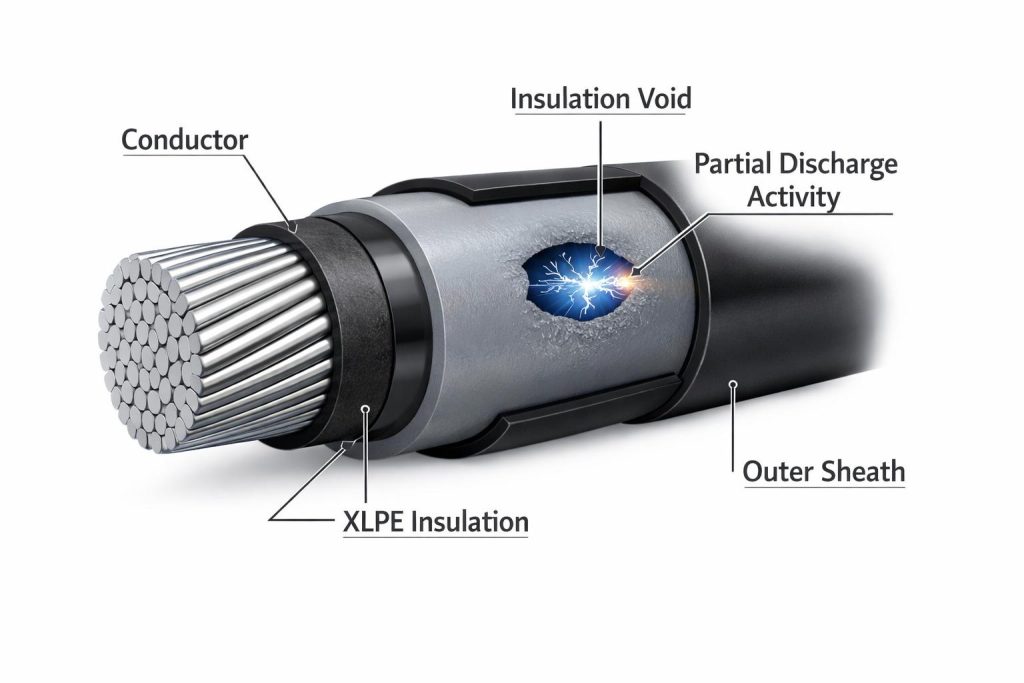
Figure 1: A cross-section diagram illustrating a common cause of Partial Discharge Cable failure: a void within the XLPE insulation. The localized electrical spark erodes the insulation, leading to progressive degradation.
Causes of Partial Discharge in HV Cables
The root causes of PD in cables can be broadly categorized into three areas:
| Category | Description | Examples of Defects |
| Manufacturing Defects | Imperfections introduced during the cable production process. | Voids, contaminants, or water trees within the insulation layer. |
| Installation Stress | Damage or poor workmanship during cable laying and jointing. | Poorly prepared cable ends, sharp edges, incorrect stress cones, or improper jointing/termination. |
| Operational Stress | Deterioration due to continuous service conditions. | Thermal cycling, excessive electrical stress, moisture ingress, or material aging. |
Partial Discharge Cable Testing: Online vs. Offline
Effective Partial Discharge Cable testing is crucial for condition-based maintenance. The choice between online and offline testing methods depends on operational requirements and the desired level of diagnostic detail.
1. Online PD Testing
- Method: Performed while the cable is energized and in service.
- Detection: Typically uses non-intrusive sensors like High-Frequency Current Transformers (HFCTs) clamped around the cable’s ground lead or acoustic sensors on terminations.
- Advantages: No service interruption; ideal for continuous monitoring and trend analysis.
- Disadvantages: Susceptible to external noise and interference; generally less sensitive than offline methods.
2. Offline PD Testing
- Method: Requires the cable to be de-energized and isolated from the grid. A separate voltage source (often VLF – Very Low Frequency) is applied.
- Detection: Highly sensitive measurements are taken in a controlled environment.
- Advantages: High sensitivity; allows for controlled voltage application to initiate PD; less external noise.
- Disadvantages: Requires service interruption; more time-consuming and costly.

Figure 2: A technician conducting an online Partial Discharge Cable test on a high-voltage cable termination using a handheld diagnostic device and an HFCT sensor. This method allows for critical assessment without interrupting power service.
The Benefits of Proactive PD Cable Monitoring
Integrating a robust Partial Discharge Cable monitoring program offers significant long-term benefits:
- Preventative Maintenance: Shifting from reactive failure response to predictive maintenance, allowing repairs to be scheduled before a fault occurs.
- Asset Life Extension: Identifying and mitigating PD early prevents irreversible insulation damage, significantly extending the operational lifespan of expensive cable assets.
- Cost Reduction: Avoiding unexpected outages eliminates the high costs associated with emergency repairs, lost revenue, and penalties for service interruption.
- Enhanced Safety: Reducing the risk of sudden electrical failures, which can pose serious safety hazards to personnel and equipment.
- Optimized Capital Planning: Accurate condition assessment provides data-driven insights for prioritizing cable replacement or refurbishment projects.
Conclusion
The reliability of the electrical grid hinges on the health of its cables. By implementing regular and sophisticated Partial Discharge Cable testing, operators can gain critical insights into the true condition of their assets. This proactive approach ensures system stability, maximizes asset utilization, and secures the long-term operational efficiency of high-voltage networks. Investing in advanced PD testing technology is an investment in the future reliability of power infrastructure.