
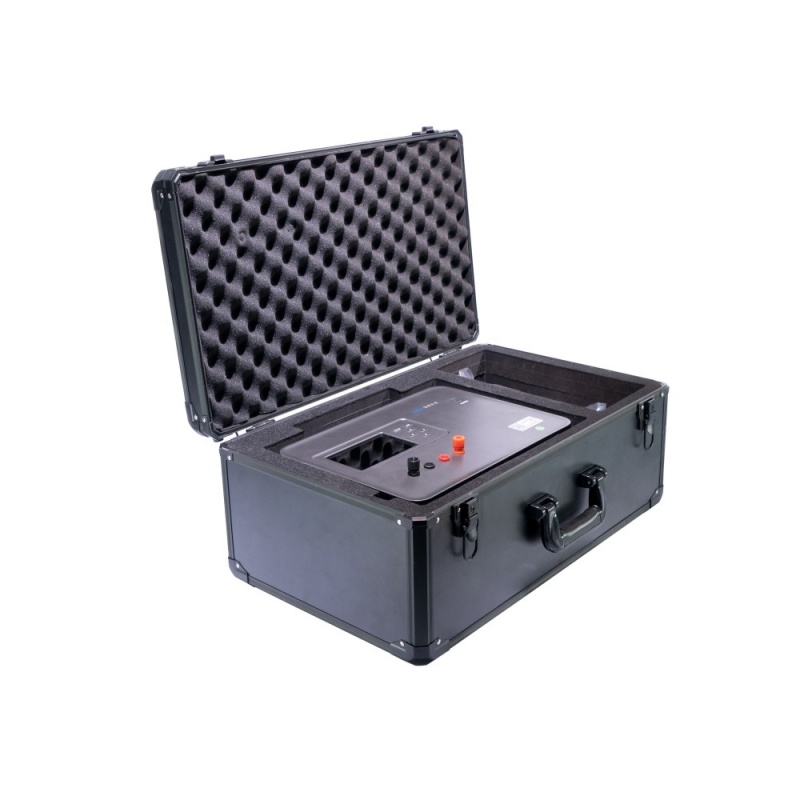
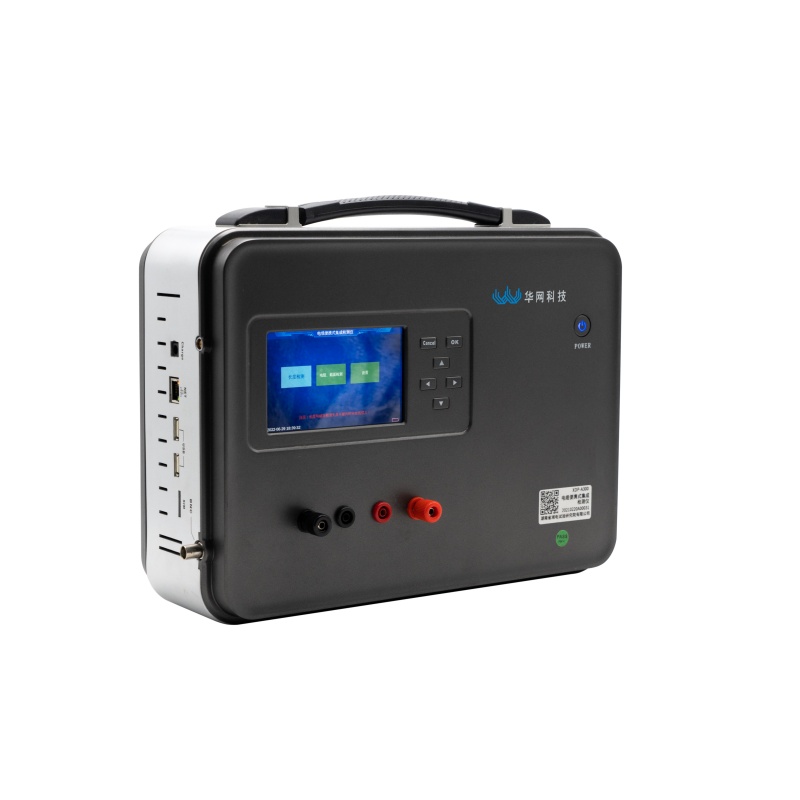
Model: HMJ9030
Product Overview:
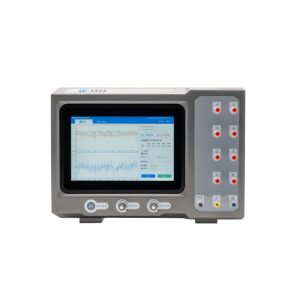
The HMJ9030 Portable Integrated Cable Tester is a multifunctional instrument capable of measuring cable length, cross-sectional area, and material type. As power cables play a crucial role in power transmission, their safe and reliable operation is essential for maintaining the stability of power distribution systems. With the increasing use of power cables in recent years, precise and efficient testing tools have become increasingly important.
This device primarily addresses three key areas:
- Cable length measurement
- Cable material identification
- Cable cross-sectional area measurement
Key Features:
- Length Measurement:
- Displays waveforms of cable length detection
- Shows propagation time and final measurement results
- Stores data from the most recent 10 cable length measurements
- Cross-Sectional Area Detection:
- Displays pre- and post-identification images
- Shows diameter, cross-sectional area, and inclination angle for A, B, and C phase cables
- Stores data from the last 3 cross-section measurements
- Material Identification:
- Supports both manual setting and automatic acquisition of cable length and cross-section parameters
- Displays resistance value, resistivity, and material type in the interface
- Stores data from the most recent 10 material identification tests
Technical Specifications:
| Item | Specification |
| No-load Output Pulse Amplitude | 15–18V |
| Pulse Frequency | 250–350Hz |
| Output Waveform Rise Time | ≤1μs |
| Sampling Accuracy | 12 bits |
| Screen Resolution | 800×480 |
| Operating System | Embedded Linux |
| Resistance Measurement Range | 10μΩ – 200kΩ |
| Resistance Measurement Resolution | 10μΩ |
| Resistance Measurement Accuracy | <0.5% |
| Dimensions | 350mm × 258mm × 115mm |
Frequently Asked Questions about portable integrated cable tester
What is the portable integrated cable tester (HMJ9030) used for?
The portable integrated cable tester — model HMJ9030 is designed for on-site cable insulation diagnosis, fault location and withstand testing. It is deployed in power cable commissioning, maintenance and fault repair, where it gives maintenance teams continuous or periodic visibility of insulation condition so that defects can be identified before they develop into unplanned outages.
What is the pulse frequency of the HMJ9030?
According to the published specification, the pulse frequency is 250–350Hz. This figure is measured under the reference conditions stated in the product datasheet; for project-specific acceptance criteria please refer to the type test report supplied with the quotation.
What does the test result tell me about the cable condition?
The HMJ9030 excites the cable and records the discharge activity as a function of the applied voltage. The key outputs are the partial discharge inception voltage, the discharge magnitude at test voltage, and — where a fault exists — the location of the discharge site or the fault itself along the cable. Comparing these values against the commissioning record and against previous tests is what supports a repair-or-continue decision.
Is installation possible without an outage?
In most cases yes. Because the portable integrated cable tester is installed on the equipment while it remains energised, the work is normally carried out as a live-line operation by qualified personnel following the site safety rules. Where a sensor must be coupled to an earthed screen, bonded connection or gas compartment, a short outage may be required — this is confirmed during the site survey.
Does HUWOR support OEM/ODM and what is the delivery lead time?
Yes. Zhuhai Huawang Technology Co., Ltd. supplies the portable integrated cable tester under its own brand and also supports OEM/ODM supply, including private labelling, custom firmware functions and integration with the customer’s monitoring platform. Standard units are typically quoted with a lead time confirmed at order stage depending on quantity and configuration; sample and pilot orders are supported.
Applications
The portable integrated cable tester is used for on-site cable insulation diagnosis, fault location and withstand testing. Typical installation sites include power cable commissioning, maintenance and fault repair. It is applied both on new assets, where the monitoring function is built into the asset from the start, and on existing assets where it is retrofitted to extend the information available to the maintenance team.
How it works
The instrument converts the physical quantity of interest into an electrical signal, conditions and digitises that signal in the field unit, and passes the result to the monitoring platform or to the operator. Condition assessment relies on the trend rather than on a single reading: the value recorded today is compared with the commissioning value and with the historical series for the same measurement point, and it is the direction and rate of change that indicate whether the asset is degrading.
Installation and commissioning
Installation follows three steps: a site survey to confirm the mounting position, the communication path and the power arrangement; mechanical fitting of the sensor or the use of the instrument on the test point; and finally commissioning, where the readings are verified against a reference and the alarm thresholds are set.
Standards and documentation
Type test reports, calibration certificates and installation documentation are provided with the supply. Where a project requires the equipment to be verified against a specific national or utility standard, the applicable clauses should be stated in the enquiry so that the test scope can be confirmed at quotation stage.
Related Resources: Cable Partial Discharge Testing
For cable owners and contractors planning PD testing programmes, the following guides compare methods, field practice and acceptance testing workflows.
- Partial Discharge Cable Testing: Improving High Voltage Cable Reliability
- Partial Discharge Cable Testing: Essential for High-Voltage Cable Reliability
- Cable Partial Discharge Testing: HFCT, Tan Delta and Field Practice
- Cable PD Testing Methods Compared: Oscillating Wave, HFCT and Acoustic Techniques
- Oscillating Wave Testing (OWTS/DAC) for Medium-Voltage Cables: PD Testing Without Cable Removal
- Cable Fault Location vs Partial Discharge Testing: Two Different Jobs on the Same Cable
- Cable Acceptance Testing for New Installations in Vietnam and Indonesia: Oscillating Wave Testing
- All-in-One PD Testing System: UHF, TEV, AE & HFCT Methods Explained
Related products: Cable Oscillating Wave Partial Discharge Tester
Reviews
There are no reviews yet.