
At the invitation of a client, Huawang Technology’s engineering team recently traveled to an overhead power line site in Jiangxi, China, to conduct live-line inspection services. The project site is located in an open agricultural area, where the overhead transmission lines are continuously exposed to wind, rain, contamination, and aging — conditions that can lead to partial discharge, insulator degradation, and other hidden faults. Left undetected, these issues can escalate into line failures or even large-scale power outages.
Traditional manual inspection relies mainly on visual observation and technician experience, making it difficult to detect early-stage discharge faults. This approach suffers from low efficiency, high miss rates, and often requires power shutdowns to inspect safely. To address these industry challenges, the client invited HUWOR Technology’s team to bring its self-developed HMJ9001-J Ultrasonic Inspection Device on-site to perform detailed inspection of the overhead lines — all while the lines remained energized.
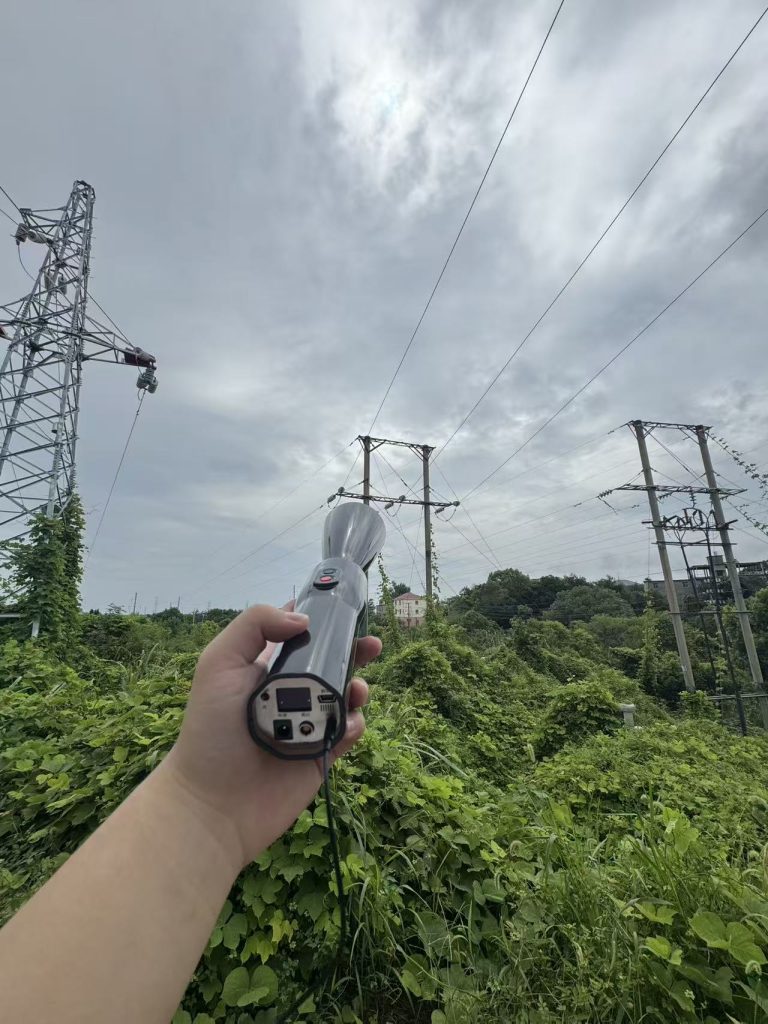
HMJ9001-J Ultrasonic Inspection Device
The HMJ9001-J is a portable power equipment fault detection instrument independently developed by Huawang Technology. It works by capturing abnormal ultrasonic discharge signals emitted from power lines, then analyzing them through built-in software to accurately determine both the location and type of fault — all without requiring a power outage. This makes it an ideal tool for live-line detection in the power industry.
Key Technical Specifications:
| Item | Specification |
| Detection Method | Live, non-contact detection |
| Effective Detection Range | ≤30 meters |
| Sensor Center Frequency | 40kHz |
| Screen Resolution | 64×48 |
| Gain Adjustment Range | 0–80dB adjustable |
| Volume Control | 1–30 levels adjustable |
| Audio Recording Duration | 1s–10s adjustable |
| Connectivity | Headphone jack, USB, data port |
| Battery Life | ≥8 hours |
| Dimensions | Φ86 × L395 (mm) |
The device is lightweight and easy to carry, and can even be used for dynamic detection from a moving vehicle at speeds up to 30km/h — significantly improving inspection efficiency, particularly in scenarios involving dense line networks or complex terrain.
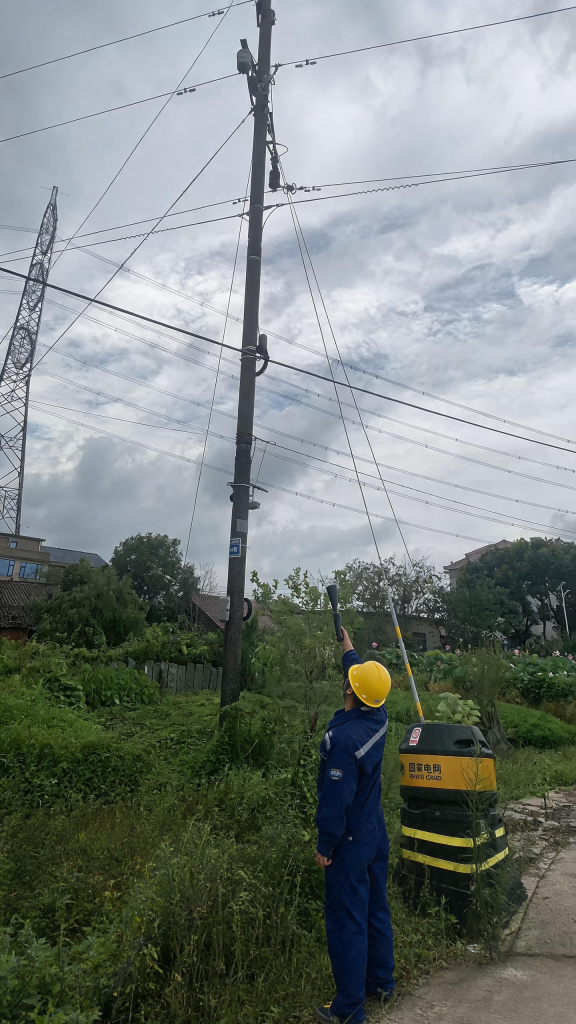
On-Site Inspection Process
Technicians held the HMJ9001-J at a safe distance and scanned the overhead lines and insulators. The device converted the captured ultrasonic signals in real time into audible sound, waveform patterns, and dB readings. By analyzing the sound characteristics and signal variations, technicians were able to quickly identify abnormal conditions such as corona discharge, surface discharge, and internal discharge, and precisely locate suspected fault points.
The entire inspection process was carried out without any physical contact and without interrupting power supply, ensuring both the safety of on-site personnel and uninterrupted operation of the grid — truly achieving the goal of “zero outage, high-efficiency” live-line inspection.
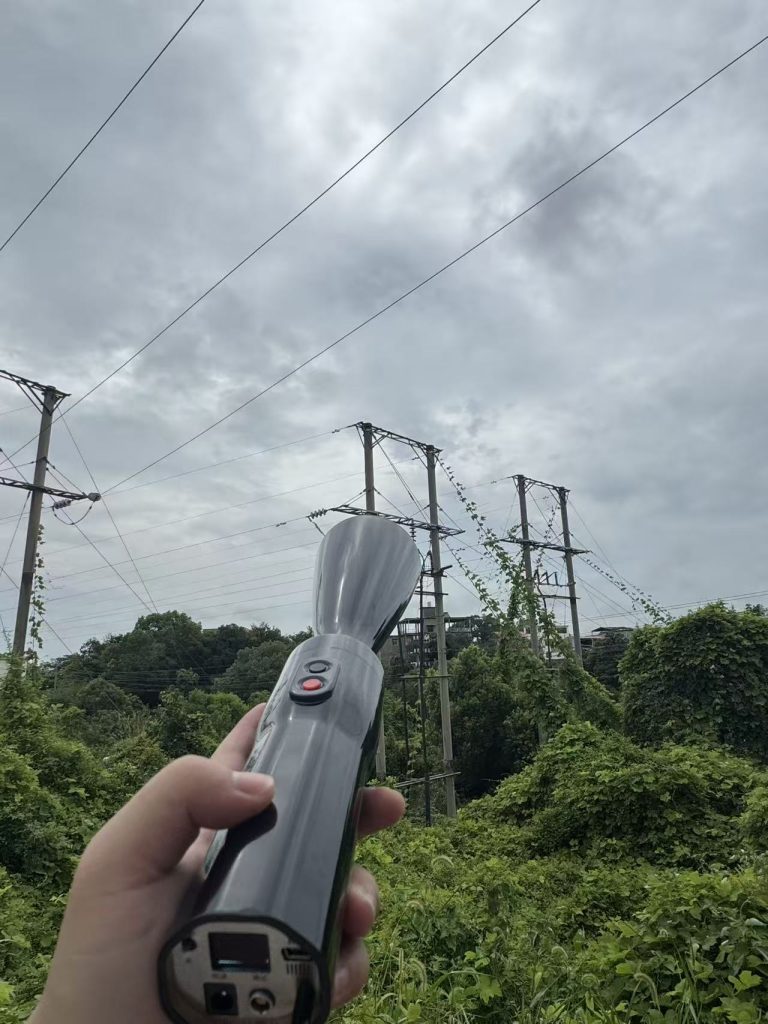
Case Value and Results
This field application confirmed the reliability and practicality of the HMJ9001-J Ultrasonic Inspection Device in real-world power inspection scenarios:
Improved Inspection Efficiency — Significantly reduces inspection time compared to traditional manual methods, and supports vehicle-based dynamic inspection.
Enhanced Power Supply Reliability — Detects discharge-related faults early, preventing escalation and reducing unplanned outages.
Lower Inspection Costs — Eliminates the need to schedule power shutdowns for testing, avoiding the economic losses associated with outages.
Reduced Labor Intensity — The portable, non-contact design lowers risks associated with high-altitude and high-voltage work.