
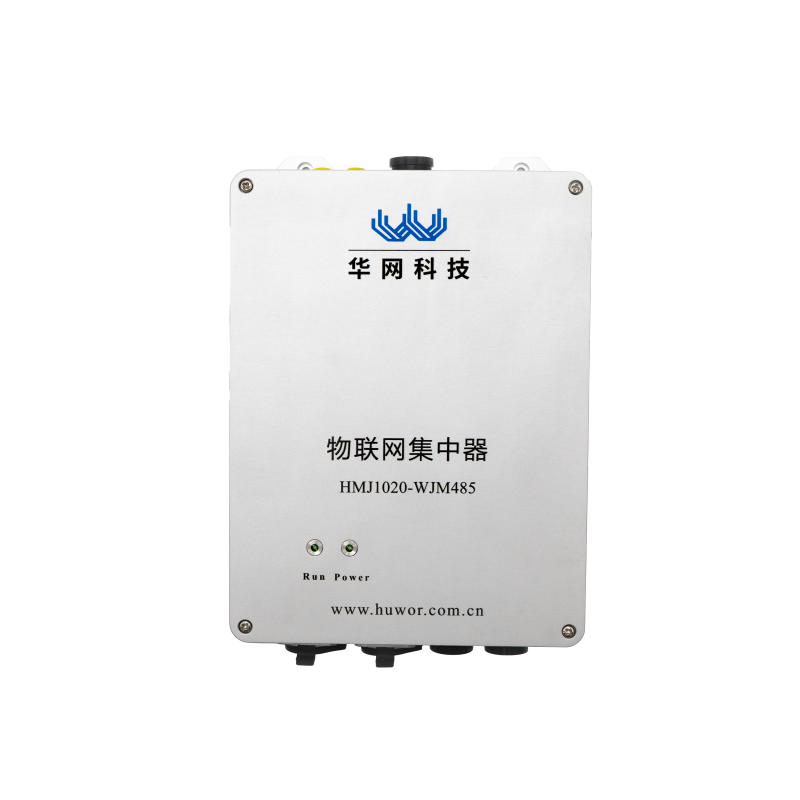
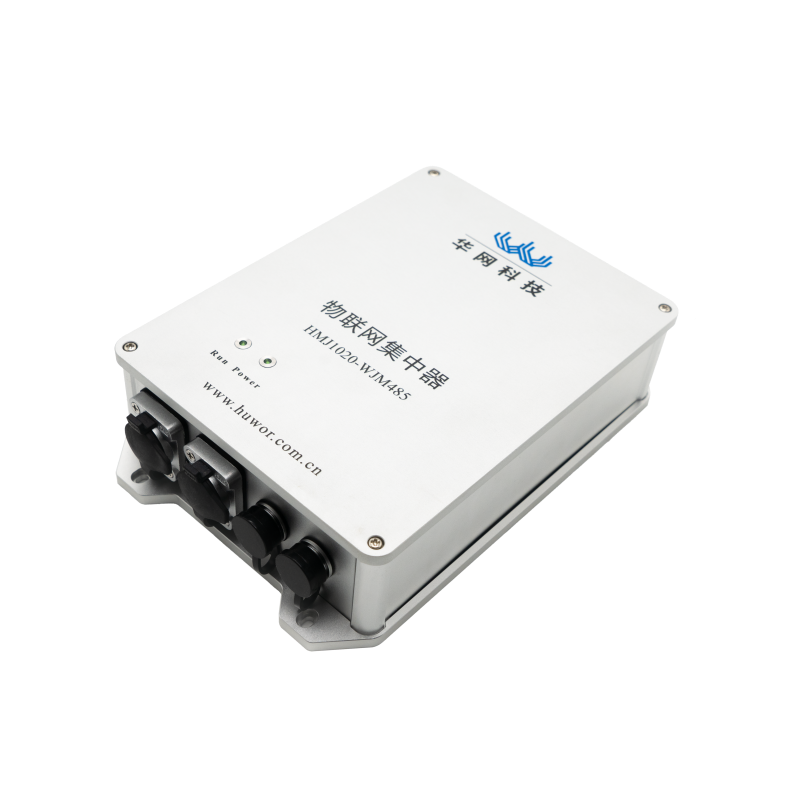
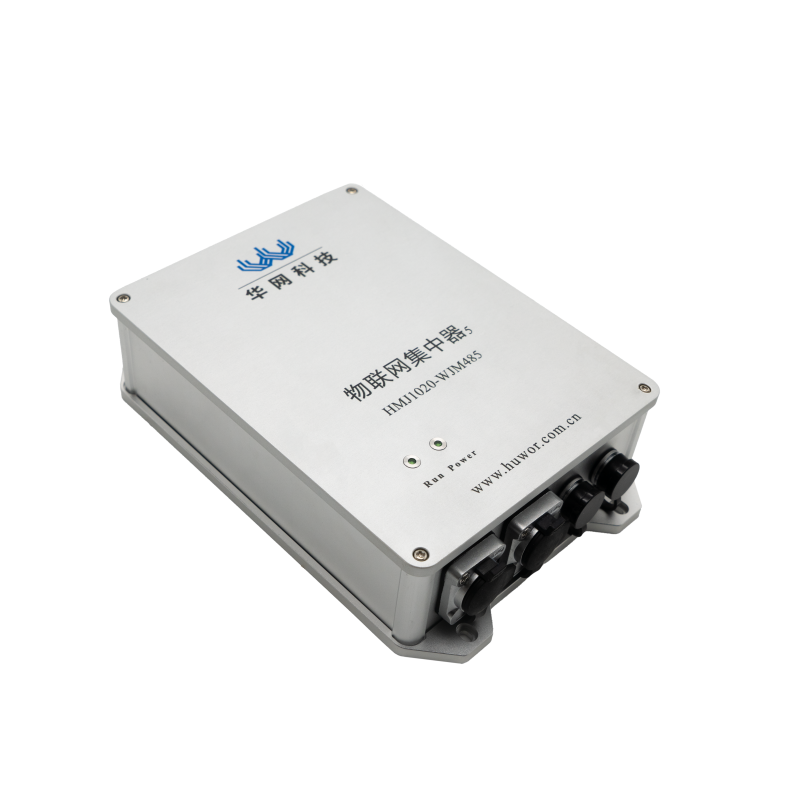
The IoT Gateway HMJ1020-WJM485 is a multifunctional relay device that supports multiple communication methods, including LoRa, RS485, Ethernet, and fiber optic connections. It integrates data acquisition, edge computing, and local data storage, making it an ideal solution for indoor monitoring environments such as distribution rooms.
With real-time processing of partial discharge, current, temperature, and other sensor data, the gateway effectively reduces server load while ensuring reliable data transmission. Even during network disconnections, it continues to operate normally, caching monitoring data locally and automatically synchronizing with the cloud once the connection is restored, ensuring data integrity and reliability.
Model:
HMJ1020-WJM485
Product Overview:
The HMJ1020-WJM485 IoT Gateway is designed to communicate with online monitoring sensors as an intermediate relay device. It supports LoRa wireless, RS485, Ethernet, and fiber optic communication for flexible networking.
By integrating data collection, partial discharge edge computing, and data storage, the gateway performs local processing to reduce transmission and server-side computing pressure. This improves real-time responsiveness and reliability in field monitoring applications.
When the network is offline, the IoT Gateway continues to monitor and store partial discharge data. Once connectivity is restored, cached data is automatically synchronized to the cloud platform, ensuring complete and accurate information.
Key Features
- Comprehensive Data Acquisition
Supports both wired and wireless communication for collecting partial discharge, current, temperature, and other parameters.
- Edge Computing Capability
Performs real-time data filtering and algorithmic analysis on-site, improving responsiveness and reducing central server load.
- IoT Communication Gateway
Converts communication protocols between sensors and the master station, supporting standard information models.
- Easy Installation
Designed for indoor use, typically wall-mounted in distribution rooms near smart sensors for quick and convenient deployment.
Technical Specifications
| Item | Specification |
| Rated Voltage / Frequency | 100–240VAC, 50Hz / 60Hz |
| Power Consumption | ≤ 8W |
| Downlink Communication | Wireless LoRa, RS485 |
| Downlink Frequency Band | 470–510MHz |
| Uplink Communication | RS485, Ethernet, Fiber Optic |
| Supported Protocols | MQTT, HTTP, Modbus |
| Communication Standards | IoT Wireless Networking Protocol for Power Transmission Equipment; IoT Low-Power Wireless Communication Protocol for Power Equipment |
| Data Transmission Standard | IoT Sensor Data Specification for Power Transmission Equipment |
| RS485 Baud Rate | Default 9600bps, adjustable 1200–19200bps |
Frequently Asked Questions about IoT gateway with multiple communication modes
What is the IoT gateway with multiple communication modes (HMJ1020-WJM485) used for?
The IoT gateway with multiple communication modes — model HMJ1020-WJM485 is designed for field data aggregation, protocol conversion and edge computing for online monitoring systems. It is deployed in substation monitoring systems and distributed sensor networks, where it gives maintenance teams continuous or periodic visibility of insulation condition so that defects can be identified before they develop into unplanned outages.
What is the rated voltage / frequency of the HMJ1020-WJM485?
According to the published specification, the rated voltage / frequency is 100–240VAC, 50Hz / 60Hz. This figure is measured under the reference conditions stated in the product datasheet; for project-specific acceptance criteria please refer to the type test report supplied with the quotation.
What role does the gateway play in an online monitoring system?
The HMJ1020-WJM485 sits between the field sensors and the monitoring platform. It aggregates data from the sensors over the field links, performs protocol conversion and edge processing, and forwards the result upstream. Using a dedicated gateway keeps the sensors themselves simple and low-power, and means the upstream interface can be changed without touching the field devices.
How is the IoT gateway with multiple communication modes powered and how does it communicate?
The HMJ1020-WJM485 uses the following interface configuration: communication is Wireless LoRa, RS485; power supply is ≤ 8W. This allows the same device to be fitted in both retrofitted installations and new builds; the exact combination is confirmed at order stage against the site communication architecture.
Is installation possible without an outage?
In most cases yes. Because the IoT gateway with multiple communication modes is installed on the equipment while it remains energised, the work is normally carried out as a live-line operation by qualified personnel following the site safety rules. Where a sensor must be coupled to an earthed screen, bonded connection or gas compartment, a short outage may be required — this is confirmed during the site survey.
Does HUWOR support OEM/ODM and what is the delivery lead time?
Yes. Zhuhai Huawang Technology Co., Ltd. supplies the IoT gateway with multiple communication modes under its own brand and also supports OEM/ODM supply, including private labelling, custom firmware functions and integration with the customer’s monitoring platform. Standard units are typically quoted with a lead time confirmed at order stage depending on quantity and configuration; sample and pilot orders are supported.
Applications
The IoT gateway with multiple communication modes is used for field data aggregation, protocol conversion and edge computing for online monitoring systems. Typical installation sites include substation monitoring systems and distributed sensor networks. It is applied both on new assets, where the monitoring function is built into the asset from the start, and on existing assets where it is retrofitted to extend the information available to the maintenance team.
How it works
The instrument converts the physical quantity of interest into an electrical signal, conditions and digitises that signal in the field unit, and passes the result to the monitoring platform or to the operator. Condition assessment relies on the trend rather than on a single reading: the value recorded today is compared with the commissioning value and with the historical series for the same measurement point, and it is the direction and rate of change that indicate whether the asset is degrading.
Installation and commissioning
Installation follows three steps: a site survey to confirm the mounting position, the communication path and the power arrangement; mechanical fitting of the sensor or the use of the instrument on the test point; and finally commissioning, where the readings are verified against a reference and the alarm thresholds are set.
For this model the relevant interface conditions are: communication Wireless LoRa, RS485, power supply ≤ 8W.
Standards and documentation
Type test reports, calibration certificates and installation documentation are provided with the supply. Where a project requires the equipment to be verified against a specific national or utility standard, the applicable clauses should be stated in the enquiry so that the test scope can be confirmed at quotation stage.