
In modern electrical power systems, Partial Discharge (PD) detection is a critical process for assessing the integrity of electrical insulation. Deterioration of insulation can lead to reduced equipment lifespan, and in severe cases, catastrophic insulation failure, resulting in explosions or major outages. Therefore, selecting a high-precision, highly efficient Partial Discharge detection equipment is essential for ensuring long-term stable operation and implementing condition-based maintenance (CBM).
The Imperative of PD Detection and Field Challenges
Partial Discharge is a key precursor to localized overheating, aging of electrical components, and mechanical wear. PD is random in nature and generates a multi-phenomena signature including electrical pulses, acoustic emissions, electromagnetic radiation, light, chemical reactions, and local heat. Traditional, single-method PD detection techniques often suffer from poor anti-interference capabilities, making them inadequate for complex field environments and diverse equipment types.
To address these challenges, our company developed the HMJ9001-Q Multi-Functional Partial Discharge Detector. Integrating four cutting-edge detection principles, it provides an all-encompassing solution for condition monitoring of power assets.
Multi-Functional Excellence: The HMJ9001-Q’s Core Strengths

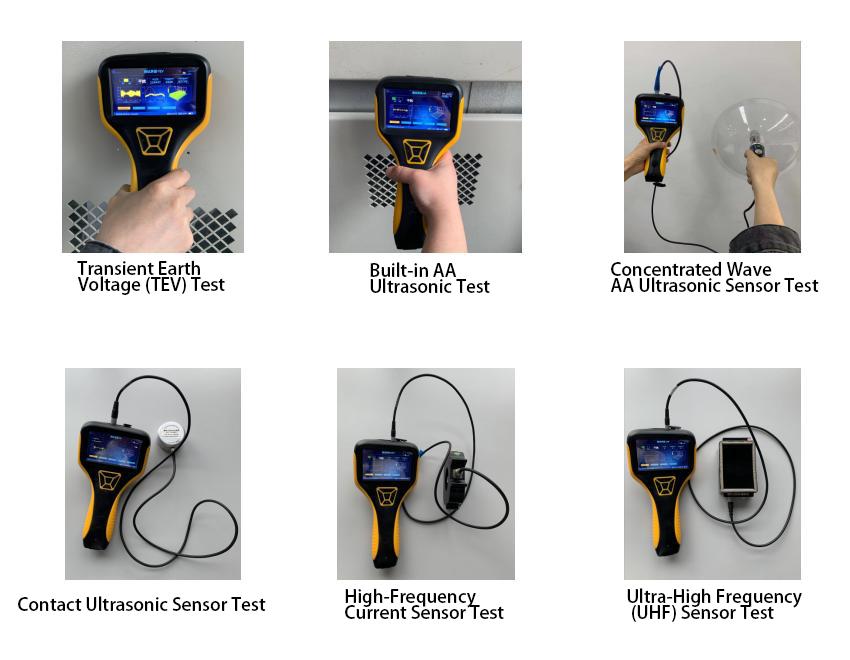
The core advantage of the HMJ9001-Q lies in its “Multi-Functionality.” It integrates five sensor types and four fundamental detection principles, allowing it to address the PD monitoring needs of virtually all high-voltage equipment, including switchgear, GIS, cables, and transformers.
| Detection Method | Sensor Type | Principle Summary | Applicable Equipment Examples |
| Transient Earth Voltage (TEV) | TEV Sensor (Built-in) | Detects high-frequency current pulses generated by PD events that propagate through grounded metal surfaces. Frequency Range: 1–100 MHz. | Switchgear, Ring Main Units (RMU) |
| Airborne Acoustic (AA) | AA Ultrasonic Sensor (Built-in/External) | Detects sound waves generated during the discharge process. Resonant Frequency: 40 kHz. | Switchgear, RMU, Overhead Lines |
| Acoustic Emission (AE) | AE Ultrasonic Sensor (External, e.g., AE-A/AE-B) | Ideal for equipment with complex internal structures where ultrasound is heavily attenuated. Frequency Range: 20–300 kHz. | GIS, Power Transformers |
| High-Frequency Current (HFCT) | HFCT Sensor (External) | Detects high-frequency pulsed current through the ground wire to diagnose discharge. Frequency Range: 0.5–30 MHz. | Cable Terminations, Cable Joints |
| Ultra High Frequency (UHF) | UHF Sensor (External) | Detects electromagnetic waves up to several GHz excited by PD. Frequency Range: 300–1500 MHz. | GIS, Power Transformers |
Notably, the UHF method effectively avoids field corona interference, offering superior sensitivity and anti-interference capability, making it especially suitable for online monitoring, localization, and defect type identification.
Ultimate Portability and Efficiency: The Ideal Field Solution
As a handheld Partial Discharge detection device, the HMJ9001-Q is designed with on-site operation needs in mind:
- Lightweight and Portable: The main unit weighs ≤0.8kg and features a compact size (267 mm*150mm*80mm), allowing for easy carrying and single-handed operation.
- Extended Endurance: The built-in 8000mAh polymer lithium battery supports ≥8 hours of continuous operation, meeting the demands of long inspection shifts.
- Smart Inspection Features: Supports “Task Inspection” and “RFID Inspection” modes. Users can create tasks, define equipment types and test points, and automatically generate inspection flows, significantly improving efficiency and data standardization.
- Comprehensive Pattern Analysis: Beyond the simple magnitude detection (using Green, Yellow, and Red severity indicators), the device provides diverse diagnostic modes, including Time Domain, Phase-Resolved Partial Discharge (PRPD, PRPS), Flight Spectrum, and Feature Index Spectrum. These features help users accurately identify PD signals and eliminate noise interference.
Broad Application: What Power Assets Can It Monitor?
The HMJ9001-Q Multi-Functional Partial Discharge Detector is an all-in-one PD detection solution suitable for condition monitoring on a wide range of electrical equipment:
- Switchgear
- Ring Main Units (RMU)
- Gas-Insulated Switchgear (GIS)
- Power Cables
- Power Transformers
- Overhead Lines
By utilizing a combination of the built-in TEV/AA sensors and various external accessories (such as the extended AA-Y, contact AE-A/AE-B, HFCT, and UHF-1 sensors), the HMJ9001-Q can flexibly switch detection modes, truly achieving one device for multiple inspection scenarios.
Conclusion
In the modern pursuit of highly reliable power systems, the choice of Partial Discharge detection equipment is paramount. With its multi-functional integration, high-precision measurement, and superior portability, the HMJ9001-Q stands as an ideal tool in the field of electrical maintenance and condition monitoring, empowering users to proactively identify and mitigate insulation risks, thus safeguarding the continuous operation of the grid.