
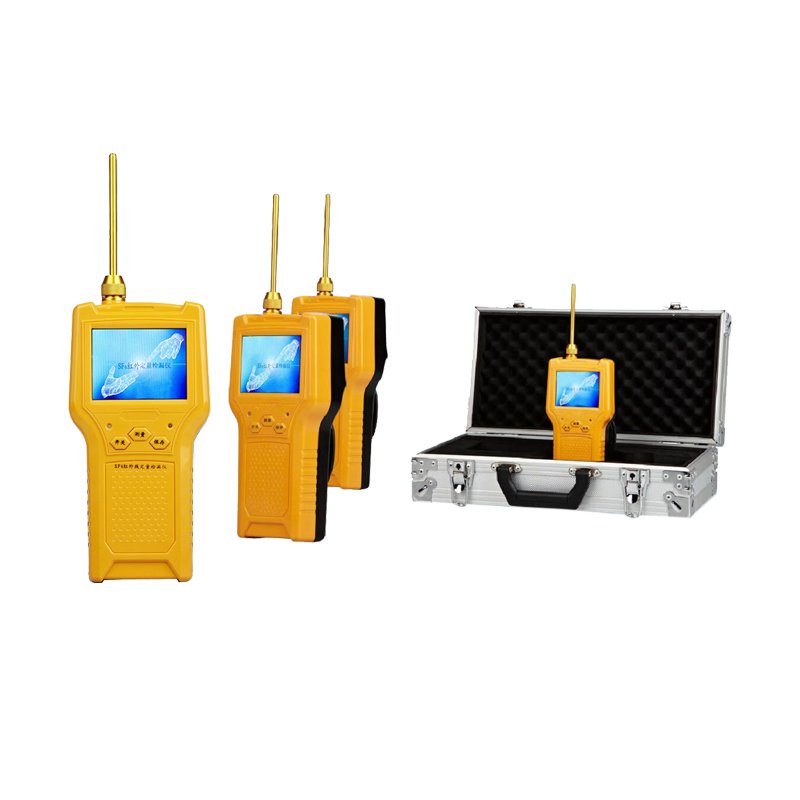
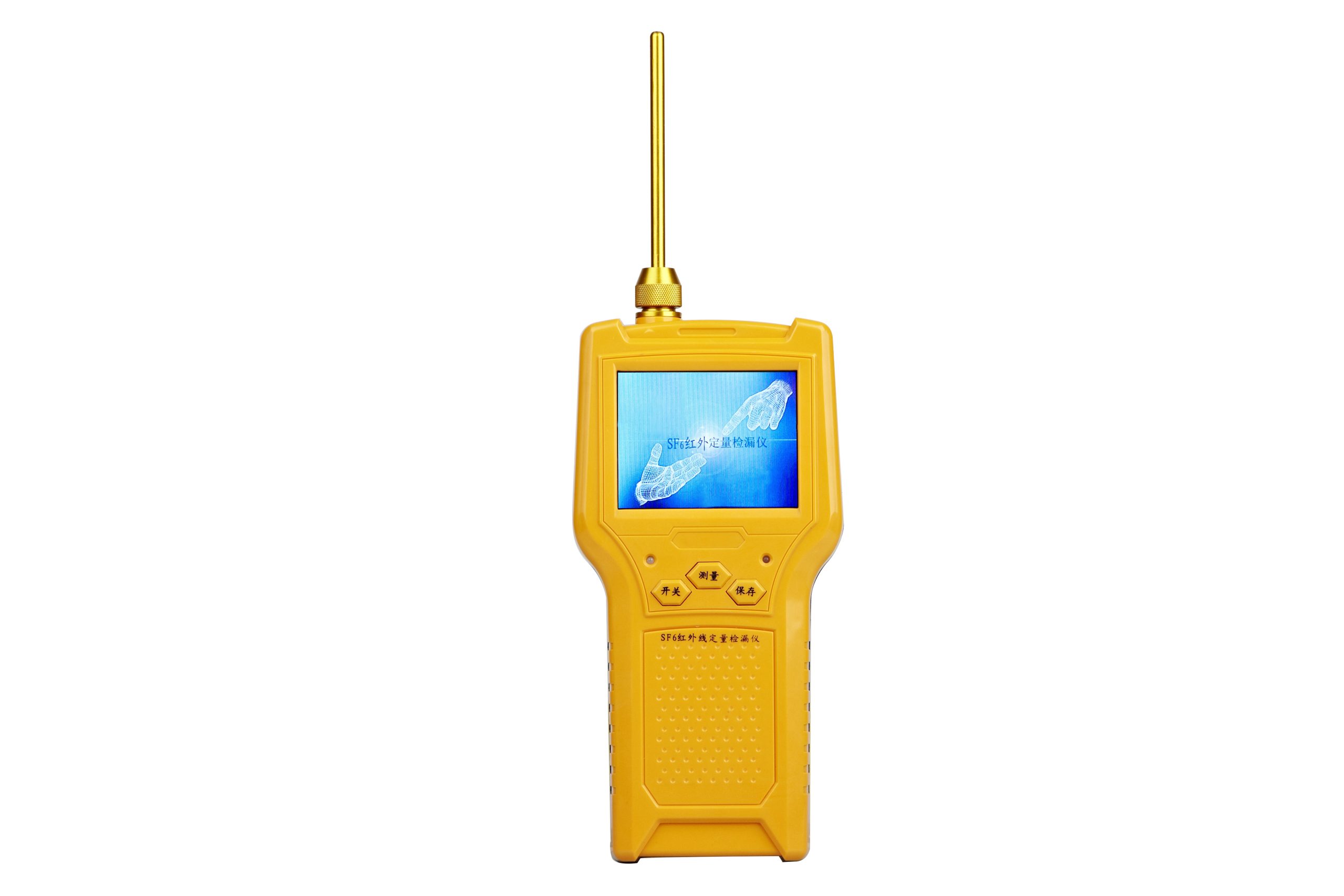
Model:HMJ-9051-S
- Product Overview
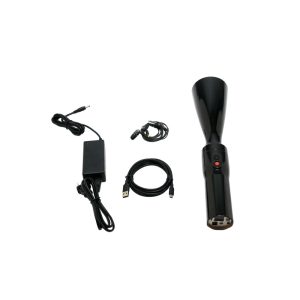
The SF6 Infrared Quantitative Leak Detector is a next-generation instrument designed to measure SF6 gas leaks. It is based on dual-beam, dual-wavelength non-dispersive infrared (NDIR) absorption spectroscopy technology. Equipped with a high-speed embedded MCU and a Chinese touchscreen human-machine interface, combined with comprehensive hardware and software design, this detector greatly enhances operational stability and detection accuracy. It can rapidly and precisely quantify leaks in SF6 circuit breakers and Gas Insulated Switchgear (GIS), while also supporting data storage and query functions.
This instrument is highly suitable for power supply departments, installation and maintenance units, and power testing research institutes. It is also an ideal supporting instrument for SF6 high-voltage switchgear manufacturers and exporters.
2. Key Features
- Utilizes dual-beam, dual-wavelength NDIR technology, improving reliability and accuracy of SF6 leak detection within the typical leak rate range of SF6 switchgear.
- Quantitatively measures trace concentrations of SF6 gas in ambient air.
- Precisely locates SF6 gas leak points in equipment.
- Quantitatively detects SF6 concentration diffusion around leaking equipment.
- Measures SF6 gas leakage volume and leak rate.
- Compact and lightweight design with anti-drop wrist strap for one-handed operation.
- Intuitive color touchscreen display for easy operation.
- Audible and visual alarms with two settable thresholds to warn when SF6 concentration exceeds limits.
- Specialized anti-interference program and data protection features for field use.
- Can store up to 8,000 test data sets.
- Rechargeable four-cell lithium polymer battery, explosion-proof and reliable, with continuous operation of up to 8 hours—ideal for field use, SF6 switchgear manufacturers, and research institutes.
- Advanced power management system with automatic standby mode.
- Compact, aesthetically pleasing design with straightforward and simple operation.
3. Technical Specifications
| Item | Parameter | Technical Data |
| Resolution | High Range Model | 1 ppm |
| High Precision Model | 0.01 ppm | |
| Detection Range | High Range Model | 0–1000 ppm |
| High Precision Model | 0–50 ppm | |
| Response Time | < 3 seconds | |
| Recovery Time | < 5 seconds | |
| Reference Error | High Range Model | ≤ ±0.5% [0–1000 ppm]; ≤ ±10% [1000–5000 ppm] |
| High Precision Model | ≤ ±0.5% [0–50 ppm]; ≤ ±10% [50–300 ppm] | |
| Repeatability Error | ≤ 2% | |
| Detection Probe Length | 130 mm (straight rod), with optional plastic hose extension at inlet | |
| Continuous Working Time | ≥ 8 hours | |
| Power Supply | Rechargeable four-cell lithium polymer battery, DC 8.4V | |
| Operating Environment | Temperature: -10℃ to 50℃; Relative Humidity: ≤ 95%, non-condensing | |
| Weight | 0.7 kg | |
| Dimensions | 330 mm × 110 mm × 70 mm |
Frequently Asked Questions about SF6 infrared quantitative leak detector
What is the SF6 infrared quantitative leak detector (HMJ-9051-S) used for?
The SF6 infrared quantitative leak detector — model HMJ-9051-S is designed for quantitative detection and localization of SF6 gas leakage. It is deployed in GIS substations, SF6 circuit breakers and switchgear rooms, where it gives maintenance teams continuous or periodic visibility of insulation condition so that defects can be identified before they develop into unplanned outages.
What is the resolution of the HMJ-9051-S?
According to the published specification, the resolution is High Range Model. This figure is measured under the reference conditions stated in the product datasheet; for project-specific acceptance criteria please refer to the type test report supplied with the quotation.
How does quantitative detection differ from a simple leak alarm?
A simple alarm only tells you that gas is present above a threshold. The HMJ-9051-S is a quantitative instrument: it measures the leak and expresses it in engineering units (this model: High Range Model), so the result can be logged, trended over time and compared with the manufacturer’s allowable leakage rate. That trend is what lets a maintenance team plan a top-up or a repair instead of reacting to an alarm.
How is the SF6 infrared quantitative leak detector powered and how does it communicate?
The HMJ-9051-S uses the following interface configuration: power supply is Rechargeable four-cell lithium polymer battery, DC 8.4V. This allows the same device to be fitted in both retrofitted installations and new builds; the exact combination is confirmed at order stage against the site communication architecture.
Is installation possible without an outage?
In most cases yes. Because the SF6 infrared quantitative leak detector is installed on the equipment while it remains energised, the work is normally carried out as a live-line operation by qualified personnel following the site safety rules. Where a sensor must be coupled to an earthed screen, bonded connection or gas compartment, a short outage may be required — this is confirmed during the site survey.
Does HUWOR support OEM/ODM and what is the delivery lead time?
Yes. Zhuhai Huawang Technology Co., Ltd. supplies the SF6 infrared quantitative leak detector under its own brand and also supports OEM/ODM supply, including private labelling, custom firmware functions and integration with the customer’s monitoring platform. Standard units are typically quoted with a lead time confirmed at order stage depending on quantity and configuration; sample and pilot orders are supported.
Applications
The SF6 infrared quantitative leak detector is used for quantitative detection and localization of SF6 gas leakage. Typical installation sites include GIS substations, SF6 circuit breakers and switchgear rooms. It is applied both on new assets, where the monitoring function is built into the asset from the start, and on existing assets where it is retrofitted to extend the information available to the maintenance team.
How it works
The instrument converts the physical quantity of interest into an electrical signal, conditions and digitises that signal in the field unit, and passes the result to the monitoring platform or to the operator. Condition assessment relies on the trend rather than on a single reading: the value recorded today is compared with the commissioning value and with the historical series for the same measurement point, and it is the direction and rate of change that indicate whether the asset is degrading.
Installation and commissioning
Installation follows three steps: a site survey to confirm the mounting position, the communication path and the power arrangement; mechanical fitting of the sensor or the use of the instrument on the test point; and finally commissioning, where the readings are verified against a reference and the alarm thresholds are set.
For this model the relevant interface conditions are: power supply Rechargeable four-cell lithium polymer battery, DC 8.4V.
Standards and documentation
Type test reports, calibration certificates and installation documentation are provided with the supply. Where a project requires the equipment to be verified against a specific national or utility standard, the applicable clauses should be stated in the enquiry so that the test scope can be confirmed at quotation stage.
评价
目前还没有评价