
In May 2026, Huawang Technology received an urgent service request from a new energy industrial park in Guangdong Province. The customer reported abnormal buzzing noises coming from critical equipment inside a 35kV high-voltage switchgear room. Suspecting insulation deterioration and concerned about the impact on production safety, they requested an immediate on-site inspection.
Our engineers promptly arrived at the site with the Huawang Technology Handheld Partial Discharge Detector. Since uninterrupted power supply was essential for the plant, the inspection was carried out under energized (live) operating conditions without shutting down the equipment.
Upon arrival, our engineers first conducted a visual inspection and an initial acoustic assessment. A distinct discharge sound was clearly audible, indicating a potential insulation defect.
To accurately locate the source of the problem, we used our self-developed handheld partial discharge detector with two complementary detection methods:
- Transient Earth Voltage (TEV) Detection
- Airborne Ultrasonic Detection
Live TEV Inspection Using Huawang Technology Handheld Partial Discharge Detector
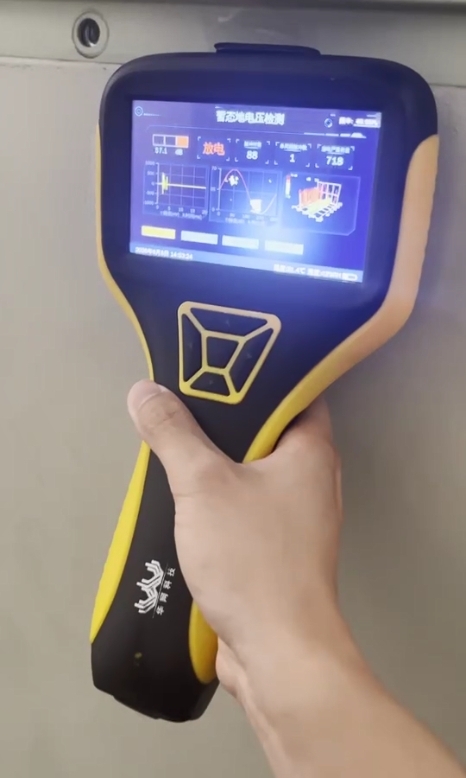
The handheld detector was first used in TEV mode to inspect the energized switchgear.
TEV Detection Results
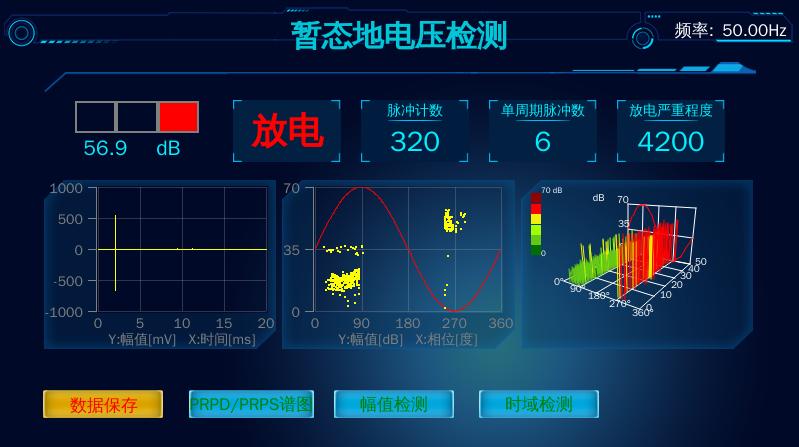
The instrument quickly detected a significant partial discharge signal with the following measurements:
- PD Level: 56.9 dB
- Pulse Count: 320 pulses
The discharge level indicated a relatively severe insulation defect. The discharge waveform was fully consistent with the abnormal buzzing sound reported by the customer, providing strong evidence of internal partial discharge activity.
Airborne Ultrasonic Partial Discharge Inspection
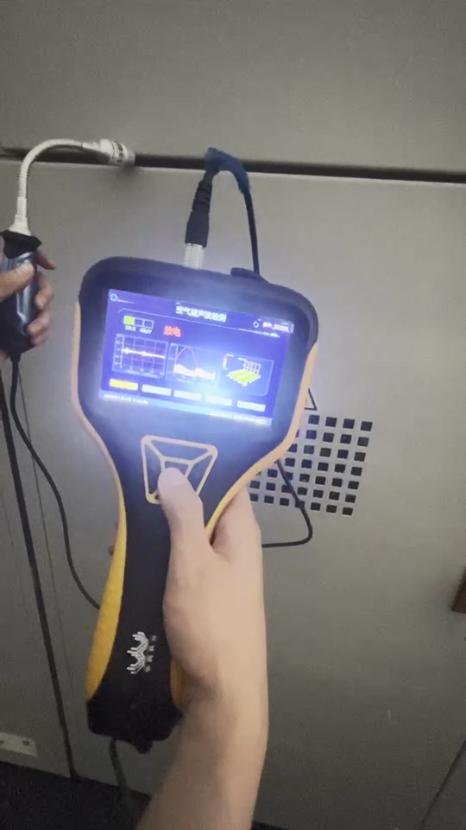
To further verify the diagnosis, the equipment was inspected using the detector’s Airborne Ultrasonic (AA) function.
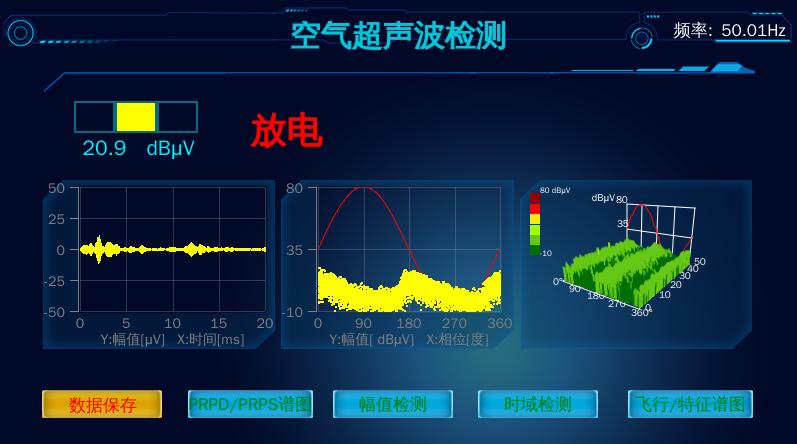
Ultrasonic Detection Results
The ultrasonic measurement recorded:Amplitude: 20.9 dBμV.The detector clearly captured ultrasonic emissions generated by the discharge, allowing our engineers to accurately confirm the fault location.
Diagnosis and Recommendations
By combining both TEV and Airborne Ultrasonic inspection methods, our engineers confirmed that the equipment was experiencing internal partial discharge. The abnormal buzzing noise was directly caused by insulation discharge activity.
A comprehensive inspection report and maintenance recommendations were provided to the customer. The plant immediately scheduled corrective maintenance, successfully eliminating the insulation defect before it could develop into a more serious equipment failure.
Project Summary
This project once again demonstrates the effectiveness of online partial discharge testing for high-voltage equipment in new energy facilities.
Compared with traditional offline inspections, live PD detection enables maintenance teams to:
- Detect insulation defects without power interruption
- Quickly identify the source of partial discharge
- Reduce unexpected equipment failures
- Improve power system reliability
- Minimize maintenance downtime and operational risks
Huawang Technology continues to provide professional partial discharge monitoring solutions, helping utilities and industrial customers maintain the safe and reliable operation of high-voltage electrical assets.