
Power transformers are among the most critical assets in electrical transmission and distribution networks. As transformers age, insulation degradation, moisture ingress, mechanical stress, and manufacturing defects can lead to partial discharge (PD) activity inside the equipment. If left undetected, these defects may develop into serious insulation failures, resulting in costly outages and unexpected downtime.
For utilities, industrial facilities, and renewable energy substations, transformer partial discharge analysis has become an essential part of condition-based maintenance strategies. Modern online monitoring technologies now allow operators to detect early-stage insulation defects and assess transformer health without interrupting service.
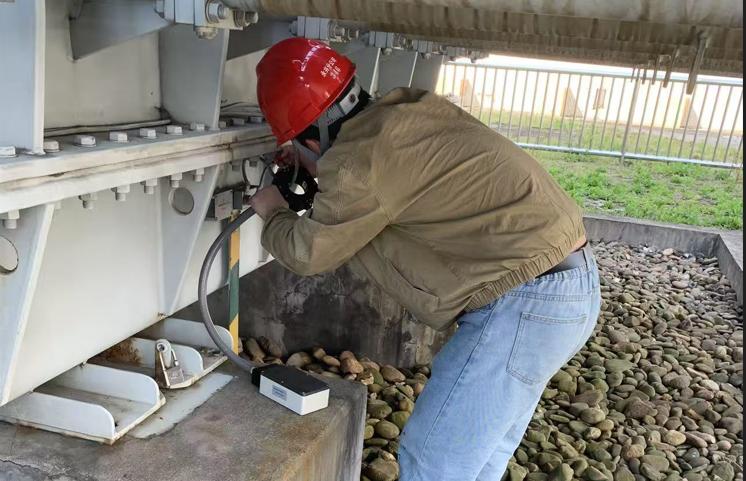
Understanding Partial Discharge in Power Transformers
Partial discharge is a localized electrical discharge that occurs within or on the surface of insulation systems under high electric stress. Although the discharge does not immediately bridge the insulation gap, repeated PD activity gradually deteriorates insulation materials and can eventually cause catastrophic failure.
Common transformer PD defects include:
- Corona discharge caused by sharp conductive points
- Floating potential discharge
- Internal void discharge within insulation
- Surface discharge along insulating materials
- Loose connections and mechanical defects
Early detection and accurate diagnosis are crucial for extending transformer service life and preventing unplanned outages.
Challenges of Traditional Transformer Inspection
Conventional transformer maintenance often relies on periodic testing during scheduled outages. While these inspections provide valuable information, they cannot continuously monitor developing insulation defects.
Many PD events occur intermittently and may not be present during routine inspections. As a result, maintenance teams increasingly adopt online partial discharge monitoring systems that provide real-time visibility into transformer operating conditions.
Dual-Technology Approach for Transformer Partial Discharge Analysis
A comprehensive transformer PD monitoring solution combines multiple sensing technologies to improve detection accuracy and reduce false alarms.
High-Frequency Current Transformer (HFCT) Monitoring
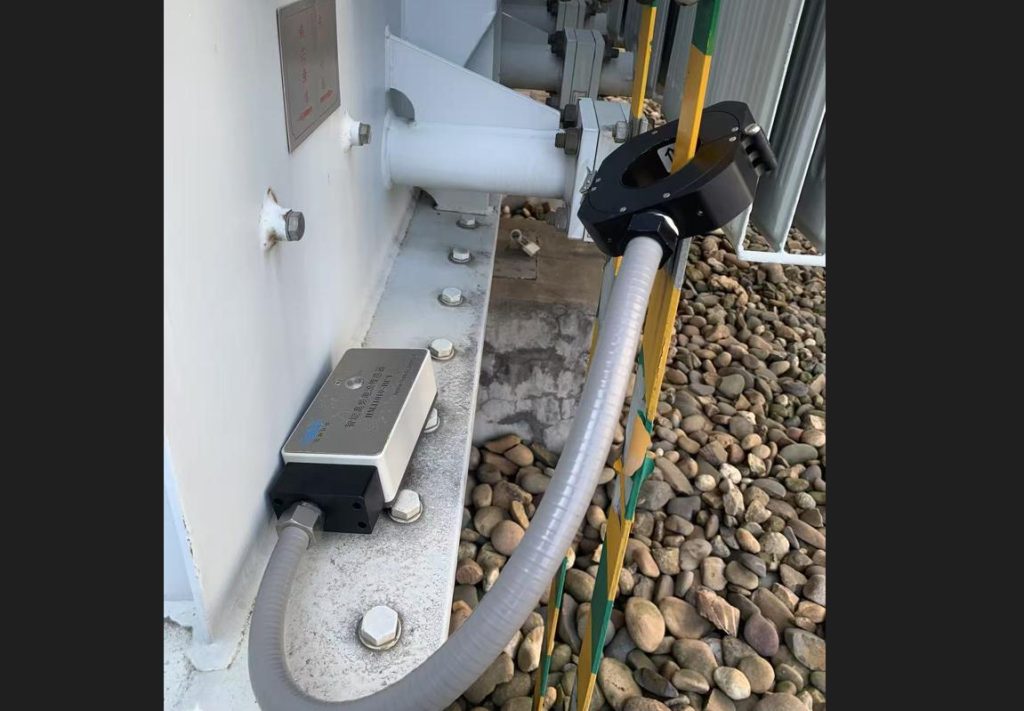
HFCT sensors are installed on transformer grounding conductors to detect high-frequency pulse currents generated by partial discharge activity.
With a wide frequency response covering high-frequency PD signals, HFCT technology offers several advantages:
- High sensitivity to weak discharge signals
- Non-intrusive installation without equipment modification
- Early detection of insulation defects
- Strong immunity to environmental interference
- Effective monitoring of transformer windings and bushings
The sensor captures discharge pulses and converts them into diagnostic data that can be analyzed for defect identification and trend assessment.
Acoustic Emission (AE) Monitoring
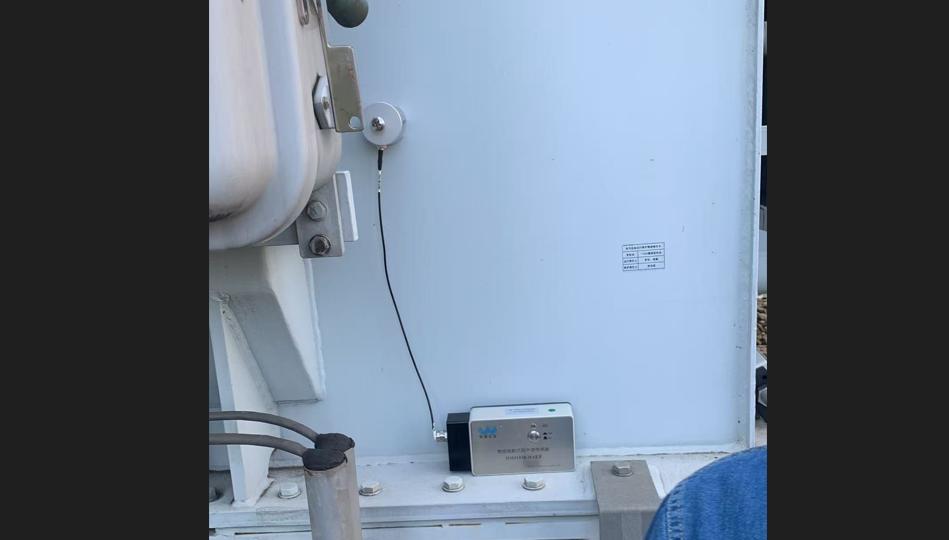
While HFCT sensors detect electrical discharge signals, acoustic emission sensors capture ultrasonic waves generated by partial discharge activity and mechanical vibrations inside the transformer.
Contact-type AE sensors mounted on the transformer tank wall provide:
- High sensitivity to internal discharge events
- Accurate localization capability
- Excellent resistance to electromagnetic interference
- Reliable operation in complex substation environments
- Compatibility with oil-filled transformers and GIS equipment
Because acoustic sensors directly contact the transformer surface, external noise influence is significantly reduced, improving diagnostic confidence.
Multi-Source Data Fusion Improves Diagnostic Accuracy
Using a single monitoring technology may sometimes lead to uncertainty when distinguishing actual PD activity from external noise sources.
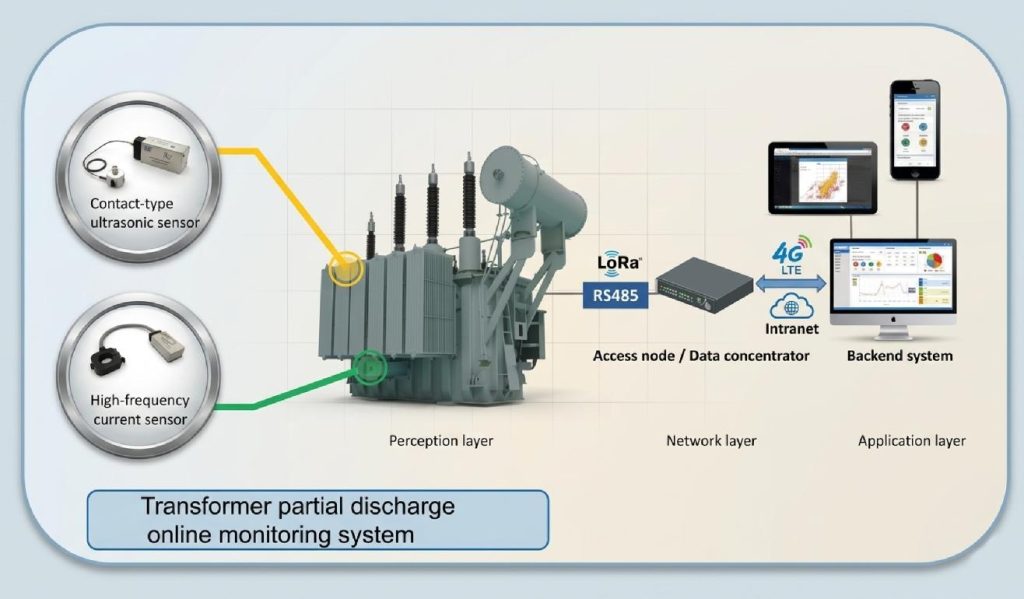
A dual-mode monitoring architecture combines HFCT electrical measurements with acoustic emission analysis to verify discharge events from two independent perspectives.
The benefits include:
- Improved defect identification
- Reduced false alarms
- Better differentiation between internal and external disturbances
- Enhanced fault location capability
- More reliable transformer health assessment
Advanced analytics can further classify typical discharge patterns such as corona discharge, floating discharge, and insulation void discharge.
Remote Online Monitoring for Smart Substations
Modern transformer monitoring systems increasingly support wireless communication architectures that simplify installation and reduce cabling costs.
HFCT and acoustic sensors can transmit monitoring data through LoRa wireless networks to local gateway nodes. The gateway then uploads data through 4G or Ethernet communication channels to centralized monitoring platforms.
This architecture enables:
- Real-time condition monitoring
- Historical trend analysis
- Early warning notifications
- Remote diagnostics
- Centralized asset management
The monitoring platform continuously evaluates discharge magnitude, activity trends, and transformer health status, helping maintenance teams make informed decisions before failures occur.
Applications in Modern Power Systems
Online transformer PD monitoring is widely deployed in:
- Utility substations
- Extra-high voltage transformers
- Renewable energy booster stations
- Industrial power distribution systems
- Smart grid infrastructure
By continuously tracking insulation performance, operators can move from time-based maintenance to condition-based maintenance, reducing operating costs while improving system reliability.
Supporting the Future of Transformer Asset Management
As power networks become increasingly digitalized, transformer monitoring technologies play a vital role in ensuring operational safety and asset longevity.
Solutions provided by Zhuhai Huawang Technology integrate HFCT sensors, contact-type acoustic emission sensors, intelligent analytics, and wireless communication technologies into a unified transformer monitoring platform. By combining electrical and acoustic diagnostics, operators gain deeper insight into transformer insulation health and can identify developing defects long before they become critical failures.
Conclusion
Transformer partial discharge analysis is one of the most effective methods for assessing insulation condition and preventing unexpected transformer failures. Combining HFCT and acoustic emission technologies delivers a more complete understanding of transformer health while enabling continuous online monitoring.
With real-time diagnostics, multi-source data fusion, and intelligent fault analysis, utilities and industrial operators can significantly improve asset reliability, reduce maintenance costs, and support the long-term performance of critical power infrastructure.