
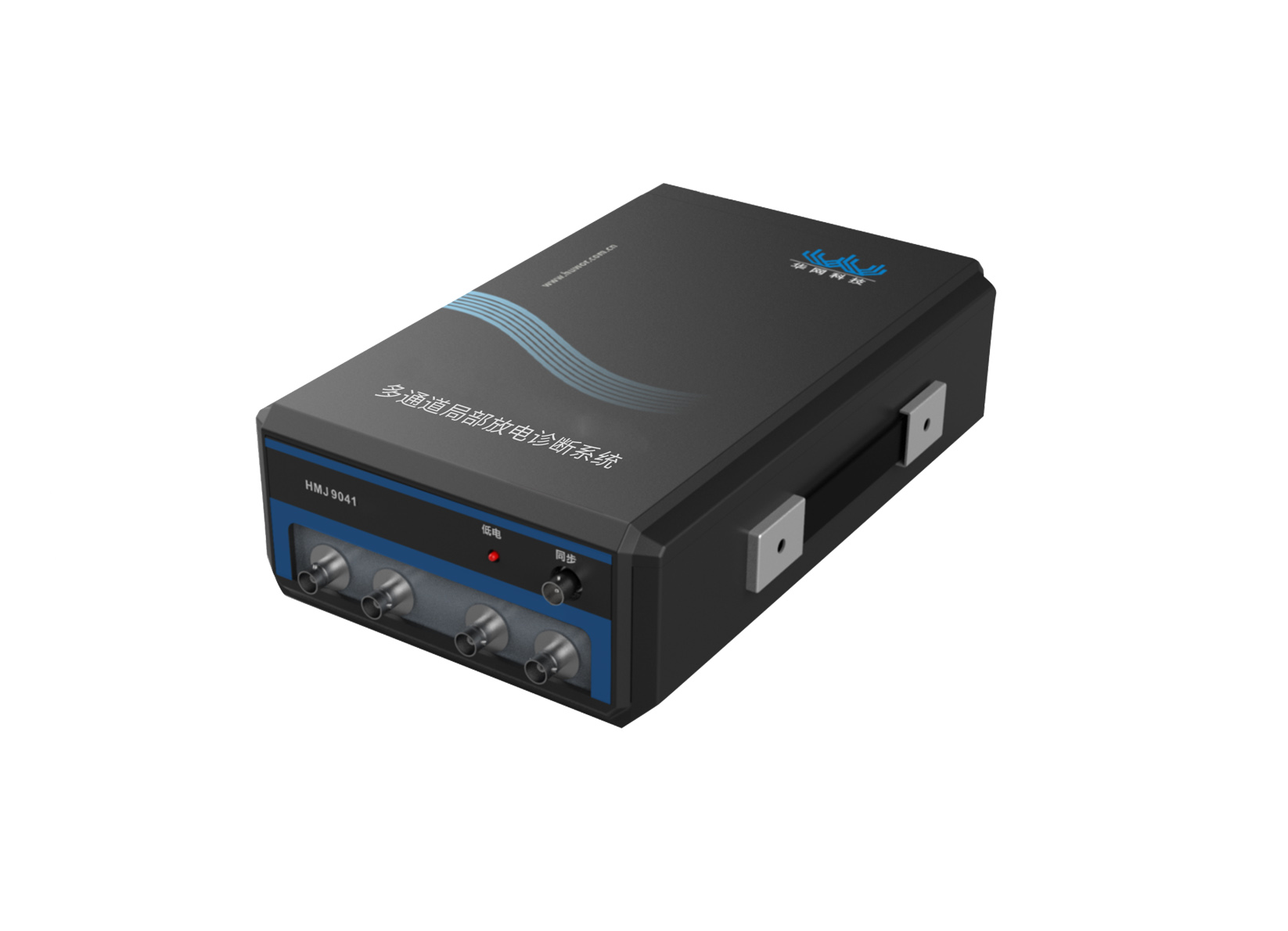
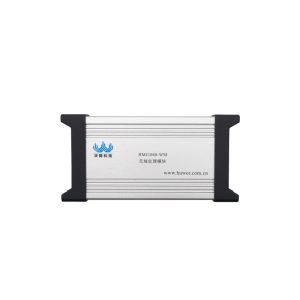
Model: HMJ9041
Product Overview
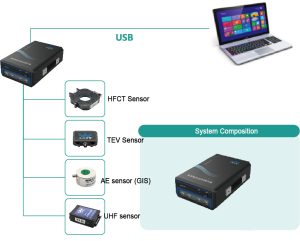
The Multi-Channel Partial Discharge (PD) Diagnosis System enables real-time, continuous live monitoring of the insulation condition inside operating electrical equipment. It employs detection principles such as Transient Earth Voltage (TEV), airborne ultrasonic, contact ultrasonic, Ultra High Frequency (UHF), and High Frequency Current (HFC) to help users eliminate potential faults before insulation failures occur. The system performs high-speed sampling of PD signals to capture complete time-domain waveforms.
Its proprietary pulse separation technology effectively filters out on-site noise during online detection. The expert database identification system incorporates signal classification algorithms including the minimum distance method, artificial neural networks with support vector machines, fuzzy logic, and statistical algorithms to identify various types of PD signals within electrical equipment. This allows for accurate diagnosis of insulation fault types and severity, providing users with valuable maintenance and repair insights.
Key Features
- Integrates sensors for TEV, airborne ultrasonic, contact ultrasonic, HFC, and UHF detection.
- Four channels simultaneously detect signal frequency and intensity, enhancing detection efficiency.
- Each channel supports over-limit alarms with red, yellow, and green indicators to show the severity of PD.
- Supports PRPS and PRPD spectrum analysis to identify discharge types.
- Features time-domain waveform detection mode to recognize typical PD waveforms and effectively distinguish interference signals.
- Equipped with unique background noise extraction and pulse threshold reconstruction for more accurate pulse extraction.
- Discharge location pinpointing based on time difference and pulse statistics, with a positioning accuracy of 0.15 meters.
- Multiple analysis algorithms provide comprehensive monitoring data analysis and automatic report generation.
Main Specifications
- Channels: 4
- Detection Bandwidth: 0–250 MHz
- Sampling Resolution: 12-bit
- Input Range: 0.1 mV–5 Vpp
- Input Impedance: 50Ω (high impedance optional)
- Interface: BNC
- Battery Life: ≥6 hours
- Synchronization Channel
- Input Voltage: 0.5–100 Vrms
- Frequency Range: 0.1–1000 Hz
- Phase Accuracy: 0.1°
- Spectrum Display: PRPD and PRPS maps
- Weight: <3.5 kg
Frequently Asked Questions about multi-channel partial discharge diagnosis system
What is the multi-channel partial discharge diagnosis system (HMJ9041) used for?
The multi-channel partial discharge diagnosis system — model HMJ9041 is designed for multi-channel synchronous partial discharge acquisition, location and diagnosis. It is deployed in substations, cable networks and HV equipment commissioning, where it gives maintenance teams continuous or periodic visibility of insulation condition so that defects can be identified before they develop into unplanned outages.
How are multi-channel measurements synchronised and located?
The HMJ9041 acquires several channels at the same time so that the arrival time and amplitude of each discharge pulse can be compared between sensors. Time-difference-of-arrival between channels is then used to locate the discharge source along the monitored section, and the phase-resolved pattern is used to classify the defect type. This is what distinguishes a diagnosis system from a simple single-point detector.
Is installation possible without an outage?
In most cases yes. Because the multi-channel partial discharge diagnosis system is installed on the equipment while it remains energised, the work is normally carried out as a live-line operation by qualified personnel following the site safety rules. Where a sensor must be coupled to an earthed screen, bonded connection or gas compartment, a short outage may be required — this is confirmed during the site survey.
Does HUWOR support OEM/ODM and what is the delivery lead time?
Yes. Zhuhai Huawang Technology Co., Ltd. supplies the multi-channel partial discharge diagnosis system under its own brand and also supports OEM/ODM supply, including private labelling, custom firmware functions and integration with the customer’s monitoring platform. Standard units are typically quoted with a lead time confirmed at order stage depending on quantity and configuration; sample and pilot orders are supported.
Applications
The multi-channel partial discharge diagnosis system is used for multi-channel synchronous partial discharge acquisition, location and diagnosis. Typical installation sites include substations, cable networks and HV equipment commissioning. It is applied both on new assets, where the monitoring function is built into the asset from the start, and on existing assets where it is retrofitted to extend the information available to the maintenance team.
How it works
The instrument converts the physical quantity of interest into an electrical signal, conditions and digitises that signal in the field unit, and passes the result to the monitoring platform or to the operator. Condition assessment relies on the trend rather than on a single reading: the value recorded today is compared with the commissioning value and with the historical series for the same measurement point, and it is the direction and rate of change that indicate whether the asset is degrading.
Installation and commissioning
Installation follows three steps: a site survey to confirm the mounting position, the communication path and the power arrangement; mechanical fitting of the sensor or the use of the instrument on the test point; and finally commissioning, where the readings are verified against a reference and the alarm thresholds are set.
Standards and documentation
Type test reports, calibration certificates and installation documentation are provided with the supply. Where a project requires the equipment to be verified against a specific national or utility standard, the applicable clauses should be stated in the enquiry so that the test scope can be confirmed at quotation stage.
Related Resources: Online Partial Discharge Monitoring
For utilities and EPC buyers evaluating online PD monitoring systems, the following guides cover system architecture, sensor selection, cost planning and project references.
- Transformer Partial Discharge Online Monitoring: Methods, Sensors and System Design
- Substation Online Monitoring Architecture: From Sensors to the Control Room
- Partial Discharge Online Monitoring System Cost and ROI: What to Budget For
- Online Monitoring vs Portable PD Testing: Which Should a Utility Invest in First?
- Handheld PD Detector or Online Monitoring System: Which Do You Need?
- Partial Discharge TEV Sensor: A Smarter Solution for Switchgear Online Monitoring
- 220kV GIS Partial Discharge Online Monitoring Project in Jiangxi
- 110kV GIS Online Monitoring System Project in Jiangxi, China
Related products: IoT Gateway · 4-in-1 Partial Discharge Monitoring Sensor · High Voltage Capacitor Online Monitoring Terminal
Reviews
There are no reviews yet.