
In modern substations and industrial power systems, insulation failure rarely happens without warning. Before a major breakdown occurs, electrical assets often produce early symptoms such as partial discharge (PD), corona activity, ultrasonic noise, or transient electromagnetic pulses. Detecting these warning signs early is critical for preventing outages and reducing maintenance costs.
This is why partial discharge and corona detection has become an essential part of predictive maintenance programs for utilities, switchgear manufacturers, and industrial facilities.
A new generation of handheld diagnostic instruments now combines multiple sensing technologies into one portable platform, allowing engineers to perform fast on-site inspections across different types of high-voltage equipment.
What Is Partial Discharge and Corona Detection?
Partial discharge refers to localized electrical discharges that only partially bridge insulation between conductors. Corona discharge is a related phenomenon caused by ionization around high electric field regions, often occurring near sharp conductors or insulation defects.
These issues can appear in:
- Medium-voltage switchgear
- GIS substations
- Power transformers
- Cable joints and terminations
- Ring main units (RMUs)
- Overhead transmission lines
If left undetected, partial discharge can gradually damage insulation and eventually lead to catastrophic equipment failure.
Corona activity may initially seem less severe, but prolonged exposure can still accelerate insulation aging, increase energy loss, and generate electromagnetic interference.
Why Traditional Single-Method Detection Is No Longer Enough
Many older inspection tools rely on only one sensing method. However, different equipment types and defect modes generate different signal characteristics.
For example:
- Internal insulation defects may generate strong UHF signals
- Surface discharge may be easier to detect using ultrasonic sensors
- Cable grounding faults may require HFCT measurement
- Metal-enclosed switchgear often benefits from TEV detection
Because of this, modern maintenance teams increasingly prefer integrated instruments capable of combining several detection technologies within a single device.
Multi-Technology Detection Improves Accuracy
According to the multifunction handheld partial discharge detector manual, the instrument supports multiple diagnostic methods including:
- TEV (Transient Earth Voltage)
- Airborne Ultrasonic (AA)
- Contact Ultrasonic (AE)
- HFCT (High Frequency Current Transformer)
- UHF (Ultra High Frequency)
The system also supports waveform analysis modes such as:
- Amplitude analysis
- Time-domain analysis
- PRPD/PRPS spectrum analysis
- Flight and feature spectrum analysis
These functions help engineers distinguish actual discharge activity from environmental interference.
TEV Detection for Switchgear Inspection
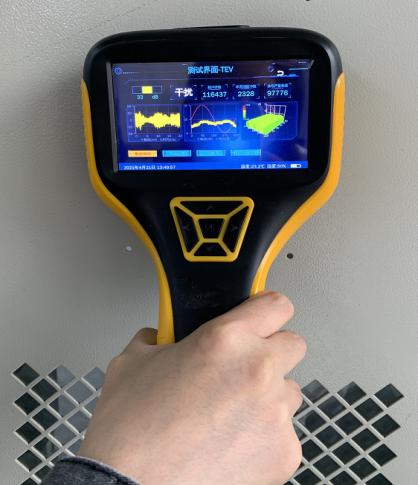
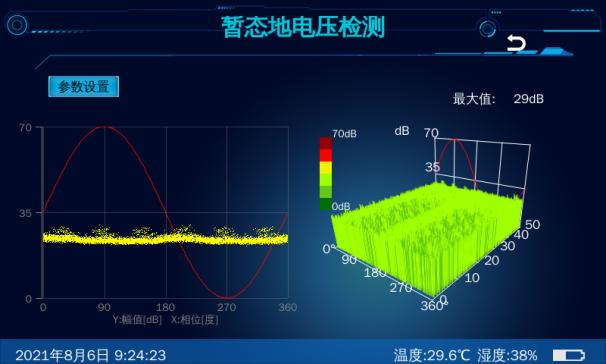
TEV technology is widely used for medium-voltage switchgear partial discharge inspection.
The manual describes TEV testing as a built-in function where the sensor is placed directly against the inspection point without additional wiring.
This approach allows maintenance personnel to quickly scan metal-clad switchgear panels during energized operation.
Ultrasonic Detection for Corona and Airborne Discharge
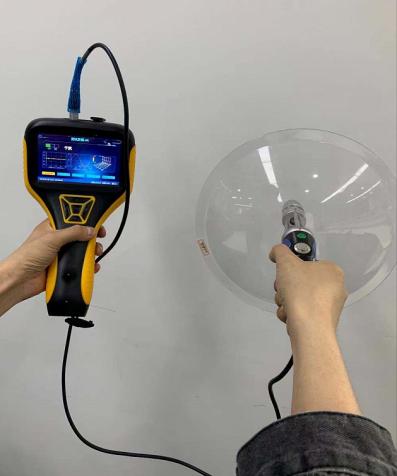
Corona discharge often generates airborne ultrasonic signals before visible damage occurs.
The handheld detector supports both built-in and external airborne ultrasonic sensors for corona detection applications. The manual notes that directional ultrasonic probes can be used for switchgear rooms and overhead line inspection.
This is particularly useful for:
- Outdoor substations
- Cable terminations
- Insulator inspections
- Overhead transmission systems
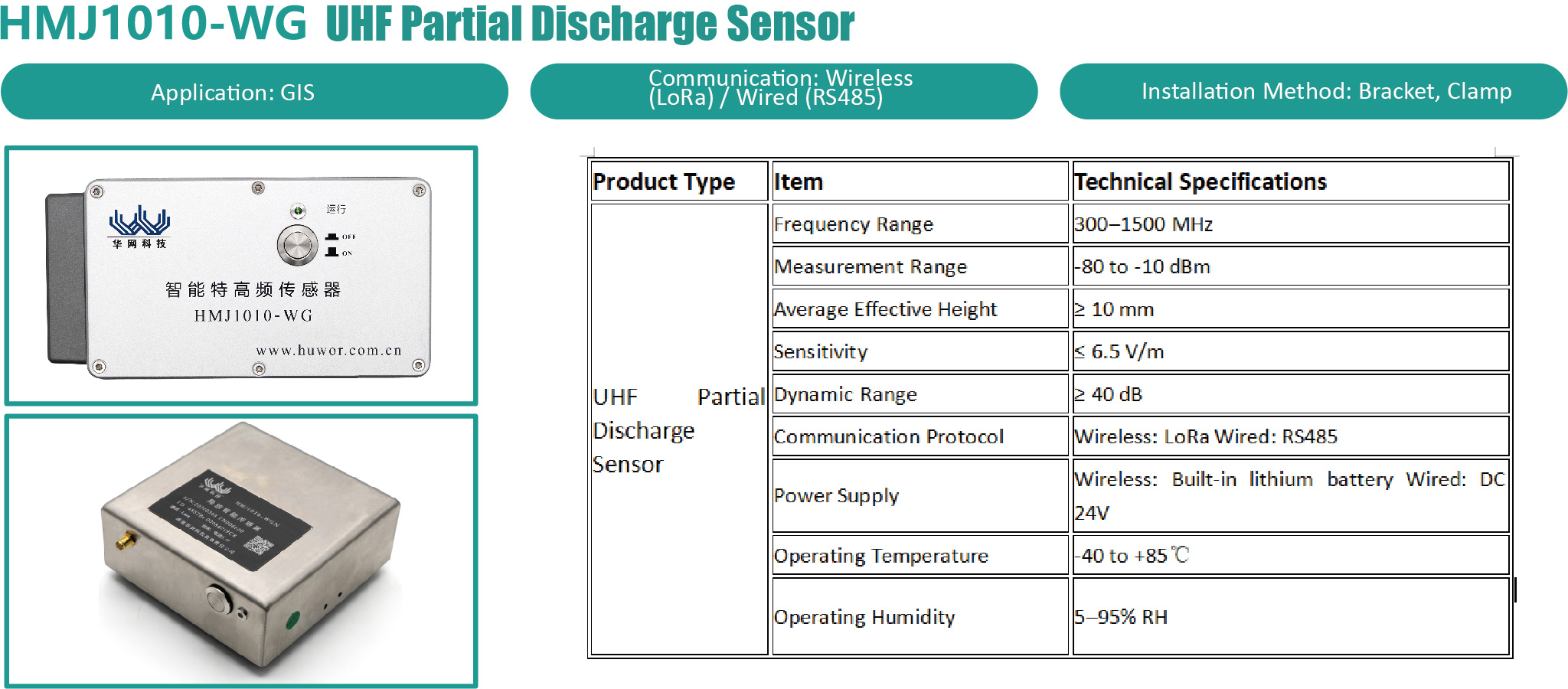
UHF Detection for GIS Partial Discharge Monitoring
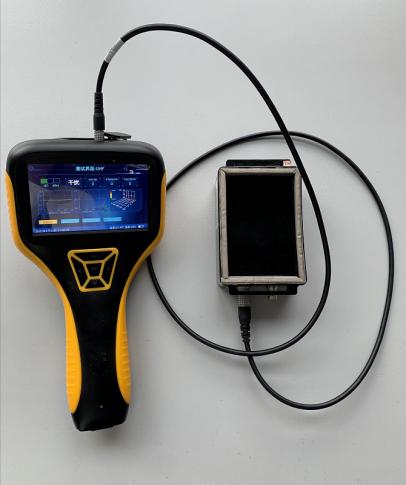
Gas-insulated switchgear (GIS) requires highly sensitive detection methods because internal defects are often enclosed within sealed metal chambers.
The instrument manual explains that the UHF sensor is mounted near the GIS basin insulator to capture ultra-high-frequency discharge signals.
UHF detection is highly effective for identifying:
- Floating discharge
- Particle discharge
- Internal insulation defects
- Surface discharge inside GIS systems
PRPD Analysis Helps Identify Defect Types
One of the most valuable functions in modern PD analysis is PRPD (Phase Resolved Partial Discharge) spectrum analysis.
The manual describes PRPD graphs as displaying discharge amplitude variation across the 360-degree phase cycle.
This analysis helps engineers distinguish between:
- Internal discharge
- Surface discharge
- Corona discharge
- Floating potential discharge
Accurate defect classification allows maintenance teams to prioritize critical assets before insulation failure develops.
Intelligent Inspection Features Improve Field Efficiency
Beyond signal acquisition, modern handheld PD instruments are increasingly designed for intelligent inspection workflows.
The manual includes features such as:
- RFID inspection management
- Task-based inspection
- Automatic data storage
- Bluetooth and WiFi communication
- Environmental condition recording
These functions help standardize field inspection procedures and simplify long-term trend analysis.
For utilities managing large substations, intelligent inspection capability can significantly improve maintenance efficiency.
Portable Partial Discharge and Corona Detection for Modern Utilities
As substations become more digitalized and maintenance strategies shift toward predictive diagnostics, portable multi-function PD detectors are becoming standard tools for field engineers.
Compared with single-function instruments, integrated handheld systems provide:
- Faster inspection speed
- Multiple detection technologies
- Better interference suppression
- Improved defect identification
- Easier field deployment
Companies such as Zhuhai Huawang Technology are developing portable partial discharge and corona detection solutions for switchgear, GIS, transformers, cables, and overhead power systems.
For utilities and industrial maintenance teams, early detection remains the most effective way to avoid costly unplanned outages.