
Partial discharge analysis has become one of the most important predictive maintenance methods for medium- and high-voltage electrical equipment. By identifying insulation degradation at an early stage, engineers can reduce unexpected outages, improve equipment reliability, and extend asset life.
Today, utilities and industrial facilities widely use portable partial discharge detection instruments to inspect:
- Medium-voltage switchgear
- GIS systems
- Power transformers
- Power cables
- Ring main units
- Overhead transmission lines
Modern handheld devices combine multiple sensing technologies into a single platform, making field inspections faster and more accurate.
What Is Partial Discharge Analysis?
Partial discharge analysis refers to the detection, interpretation, and classification of localized electrical discharges that occur inside insulation systems.
These discharges may indicate:
- Internal insulation voids
- Surface tracking
- Corona discharge
- Floating electrode discharge
- Particle discharge
If left untreated, partial discharge activity can gradually damage insulation and eventually lead to catastrophic equipment failure.
The goal of PD analysis is not only to detect discharge activity, but also to identify:
- Discharge severity
- Defect type
- Signal patterns
- Defect location
- Development trends over time
Main Technologies Used in Partial Discharge Analysis
Modern portable PD analyzers often integrate multiple detection technologies to improve diagnostic accuracy.
1. TEV (Transient Earth Voltage) Detection
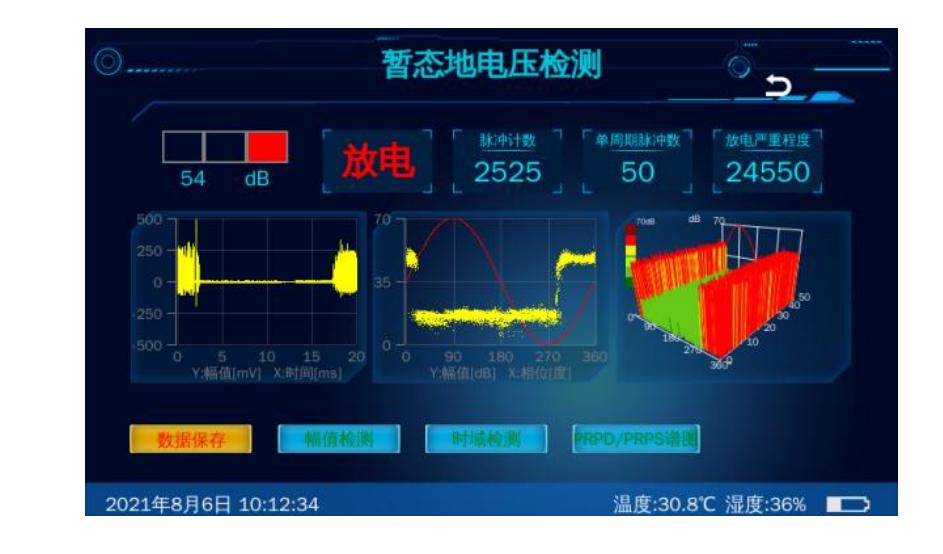
TEV detection is commonly used for metal-clad switchgear inspections.
The sensor captures transient electromagnetic pulses generated by internal discharges and propagating onto the switchgear surface.
Advantages include:
- Non-intrusive testing
- Fast inspection
- Suitable for routine maintenance
- Effective for switchgear cubicles
Some modern instruments also support:
- Time-domain analysis
- PRPD spectrum analysis
- Alarm threshold configuration
- Pulse counting
2. Airborne Ultrasonic Detection
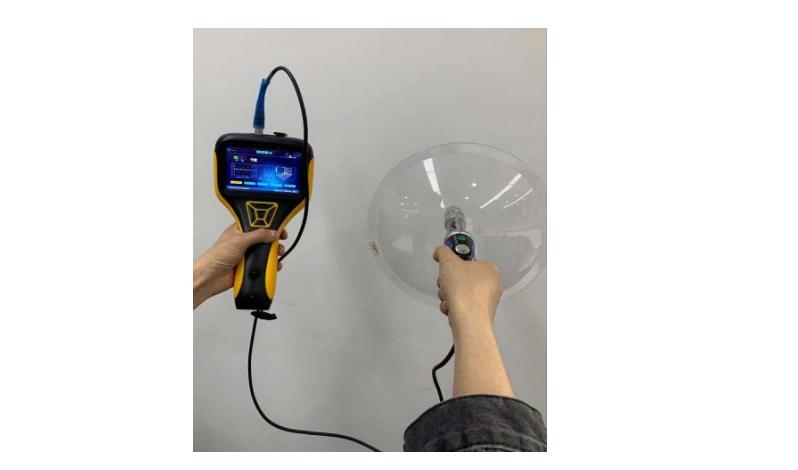
Ultrasonic PD analysis is highly effective for detecting corona discharge and surface discharge in air-insulated systems.
Portable instruments may include:
- Built-in ultrasonic sensors
- External directional sensors
- Parabolic ultrasonic sensors
- Headphone acoustic monitoring
Airborne ultrasonic inspection is especially useful for:
- Ring main units
- Open-type substations
- Cable terminations
- Overhead line inspection
Advanced PD analyzers can also provide:
- PRPD spectrum analysis
- Flight-time pattern analysis
- Acoustic recording
- Interference discrimination
3. Contact Ultrasonic (AE) Detection
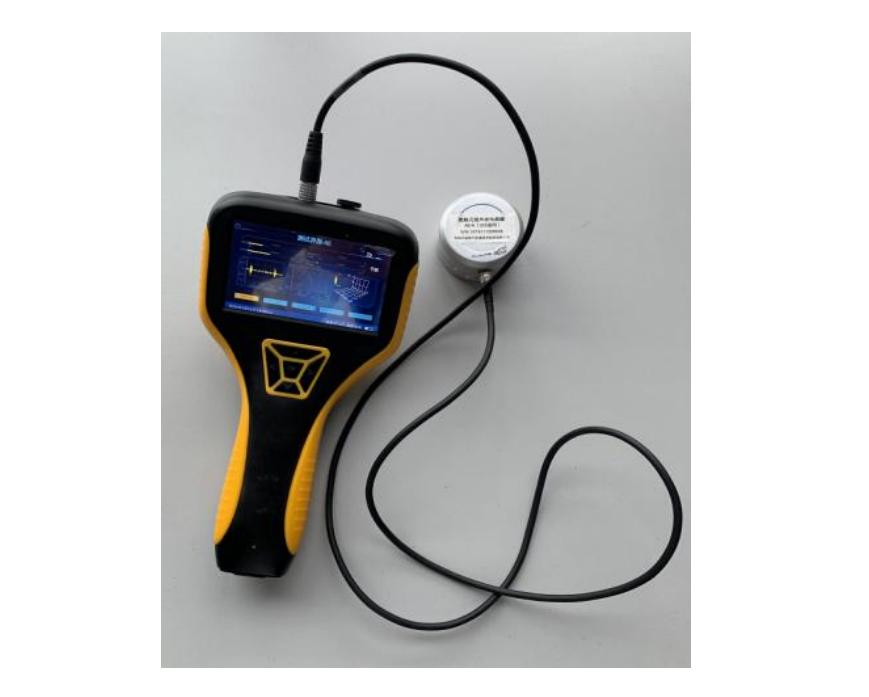
Contact ultrasonic detection is commonly applied to GIS equipment and transformer tanks.
A coupling agent is usually applied between the sensor and the equipment surface to minimize signal attenuation.
This method is sensitive to:
- Internal discharge
- Mechanical vibration caused by PD
- Arc-related acoustic activity
Many engineers prefer contact ultrasonic testing because it performs well in noisy environments.
4. HFCT (High-Frequency Current Transformer) Detection
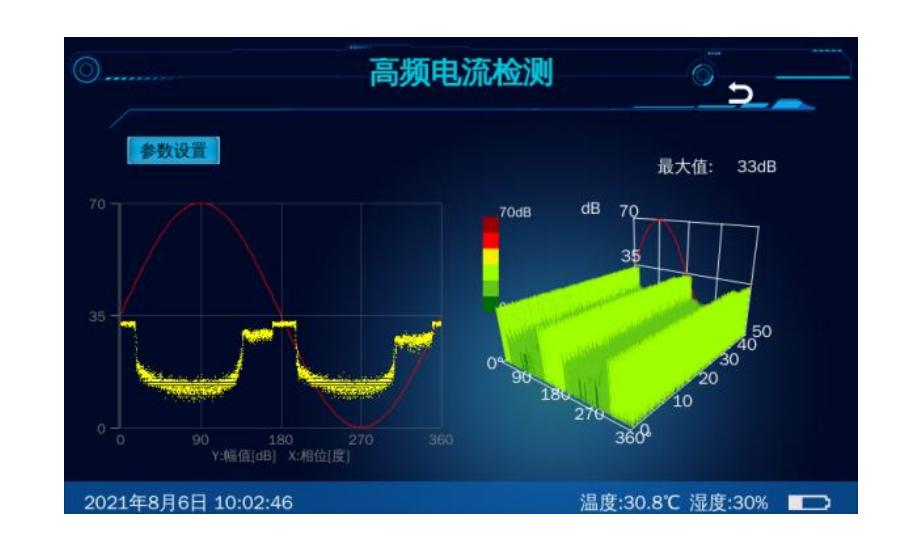
HFCT sensors are widely used for cable and transformer grounding systems.
The sensor is clamped onto the grounding conductor to capture high-frequency current pulses generated by discharge activity.
HFCT analysis can help engineers:
- Identify cable insulation defects
- Monitor transformer grounding discharge
- Analyze pulse repetition patterns
- Evaluate discharge severity
Many modern instruments support both waveform and PRPD analysis in HFCT mode.
5. UHF Partial Discharge Analysis
Ultra-high-frequency detection is one of the most reliable methods for GIS partial discharge monitoring.
UHF sensors are usually installed near GIS basin insulators to capture electromagnetic signals generated by discharge activity.
Advantages include:
- Excellent anti-interference capability
- High sensitivity
- Suitable for online monitoring
- Effective defect localization
Some advanced portable systems provide:
- PRPD/PRPS analysis
- Time-domain waveform analysis
- Alarm classification
- Multi-mode synchronization
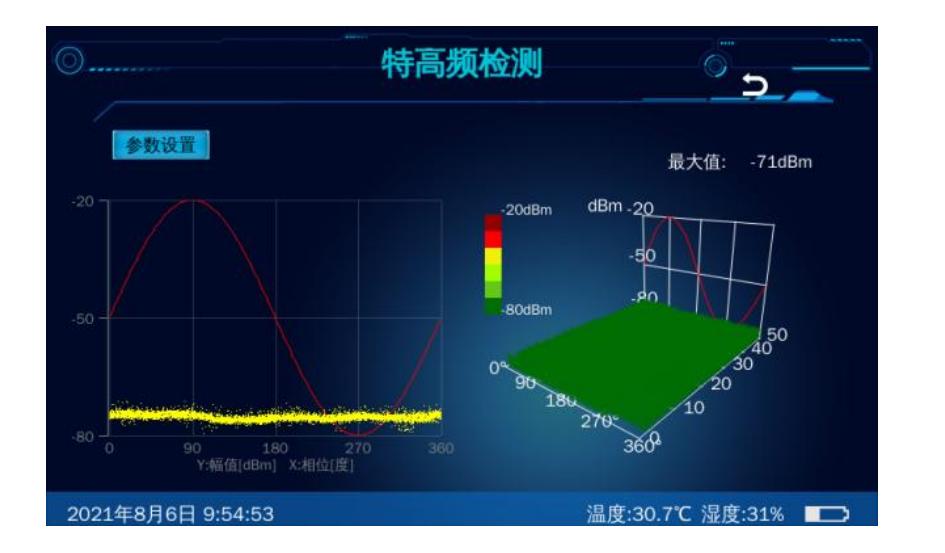
PRPD Analysis in Partial Discharge Diagnostics
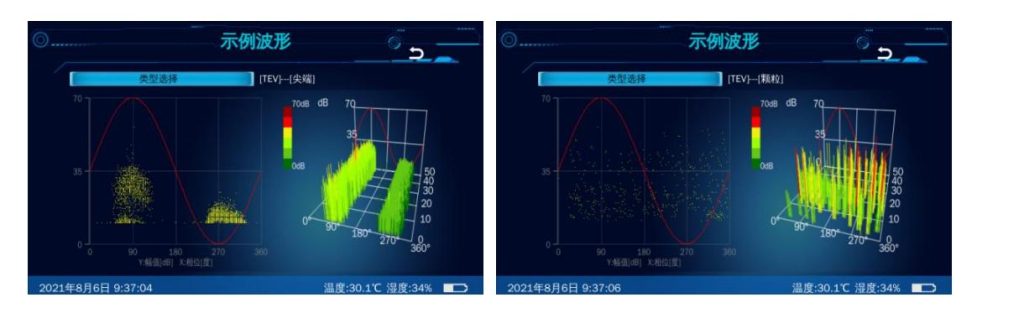
PRPD (Phase-Resolved Partial Discharge) analysis is one of the most important functions in modern PD instruments.
It helps engineers distinguish different defect types based on phase distribution patterns.
Typical discharge patterns include:
- Corona discharge
- Surface discharge
- Internal discharge
- Floating discharge
- Particle discharge
A well-designed PRPD system can significantly improve diagnostic efficiency during field inspections.
Intelligent Inspection Functions
New-generation handheld analyzers increasingly support intelligent inspection workflows.
Typical functions include:
- RFID inspection
- Task-based inspection
- Environmental recording
- Automatic data storage
- Bluetooth communication
- WiFi communication
- Android APP connectivity
These functions improve inspection efficiency for large substations and utility networks.
Some manufacturers, including Zhuhai Huawang Technology, have integrated multi-sensor PD analysis and intelligent inspection management into portable field devices.
Conclusion
Partial discharge analysis plays a critical role in modern condition-based maintenance strategies.
By combining:
- TEV
- Ultrasonic
- HFCT
- UHF
- PRPD analysis
engineers can detect insulation defects earlier and make more informed maintenance decisions.
As substations become more intelligent and asset reliability requirements continue increasing, portable multi-function partial discharge analyzers are becoming essential tools for electrical maintenance teams.