
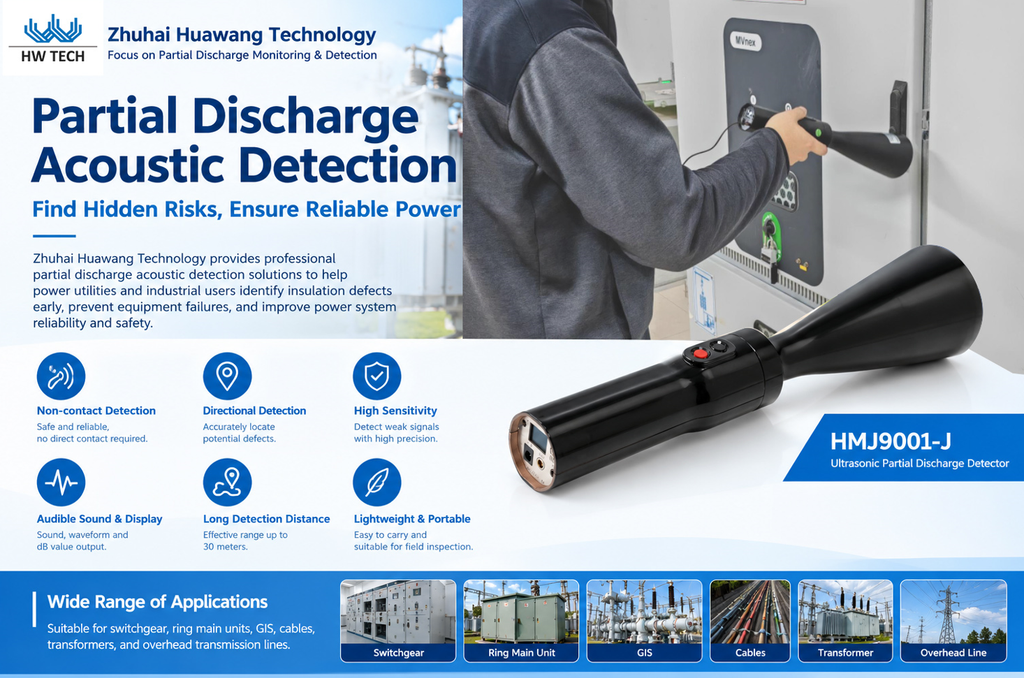
Partial discharge acoustic detection is a non-contact method used to identify ultrasonic signals generated by partial discharge and other abnormal discharge activity in electrical equipment. By detecting and analyzing these acoustic signals, maintenance teams can locate potential insulation defects before they develop into serious equipment failures.
For power utilities, substations, industrial plants, and electrical equipment manufacturers, acoustic partial discharge detection provides a practical way to inspect energized equipment without unnecessary shutdowns.
What Is Partial Discharge Acoustic Detection?
Partial discharge (PD) is a localized electrical discharge that occurs when insulation inside or around high-voltage equipment is subjected to electrical stress. Although an individual discharge may be small, repeated partial discharge activity can gradually damage insulation and increase the risk of equipment failure.
During a discharge event, energy can be released in the form of electromagnetic, acoustic, ultrasonic, and other signals.
Partial discharge acoustic detection focuses on the ultrasonic component.
A specialized ultrasonic sensor detects the high-frequency acoustic signal generated by abnormal discharge. The signal can then be converted into measurable information such as sound, waveform, and dB values, helping inspection personnel identify abnormal conditions and determine the approximate location of a defect.
Compared with direct-contact inspection methods, ultrasonic detection can be performed without physically connecting the sensor to energized equipment.
How Does Acoustic Partial Discharge Detection Work?
A typical partial discharge acoustic detection process includes four basic steps:
1. Capture ultrasonic signals
When partial discharge occurs, it produces ultrasonic sound waves that can propagate through the surrounding environment.
An ultrasonic detector captures these signals using a directional sensor.
2. Filter background interference
Electrical substations and industrial environments can contain considerable background noise. An acoustic PD detector can use sensitivity and filtering settings to help operators distinguish useful ultrasonic signals from environmental interference.
3. Analyze the detected signal
The detected ultrasonic signal can be presented as audible sound, waveform information, and dB values.
Changes in signal strength can provide useful information about the presence and location of abnormal discharge activity.
4. Locate potential defects
Because ultrasonic signals have strong directionality, operators can move the detector and compare signal strength from different positions.
The direction with a stronger signal can help narrow down the location of a potential defect.
This makes acoustic detection particularly useful for field inspection and troubleshooting.
Why Use Partial Discharge Acoustic Detection?
Non-Contact Inspection
One of the major advantages of acoustic PD detection is that inspection can be performed without direct electrical contact.
According to the HMJ9001-J product documentation, the detector supports live, non-contact inspection with an effective detection distance of up to 30 meters. This allows operators to inspect electrical equipment while it remains in normal operation.
This approach can help reduce unnecessary shutdowns and improve inspection efficiency.
Fast Fault Finding
Traditional electrical testing may require specific test arrangements, equipment connections, or planned outages.
Ultrasonic inspection can be used as a rapid field screening method. An operator can scan equipment, identify abnormal acoustic signals, and focus further investigation on suspicious areas.
Directional Detection
Ultrasonic signals have strong directionality. By changing the inspection position and observing changes in signal strength, technicians can narrow down the location of a potential discharge source.
The HMJ9001-J is designed to take advantage of this characteristic for more accurate fault positioning.
Suitable for Noisy Environments
Power equipment is often installed in environments with fans, transformers, switching equipment, and other sources of background noise.
The HMJ9001-J incorporates anti-interference capabilities and adjustable filtering to support detection in relatively noisy environments. Its filtering setting can be adjusted from 1 dB to 6 dB according to the product manual.
HMJ9001-J Ultrasonic Partial Discharge Detector
Zhuhai Huawang Technology develops and manufactures partial discharge monitoring and detection equipment for power system applications.
The HMJ9001-J Ultrasonic Partial Discharge Detector is designed for ultrasonic inspection of abnormal discharge signals, particularly for power lines and electrical equipment.
The product documentation describes the HMJ9001-J as an ultrasonic inspection device that collects abnormal discharge ultrasonic signals and uses software analysis to help identify potential fault locations and fault types.
Key Features of HMJ9001-J
- Ultrasonic detection at 40 kHz
- Non-contact live inspection
- Effective detection distance up to 30 meters
- Audible sound, waveform and dB value output
- Directional detection for locating potential defects
- Adjustable sensitivity from 20 dB to 80 dB
- Adjustable frequency from 39 kHz to 41 kHz
- Adjustable filtering
- Built-in data storage
- USB data transfer
- Portable design for field inspection
The detector uses a 40 kHz sensor and provides a 64 × 48 black-and-white display. The device also supports headphone, USB and charging interfaces.
The instrument can save detected events in its internal memory, with the manual specifying storage for up to 30 events, and saved data can be transferred to a computer through USB.
Typical Applications of Acoustic Partial Discharge Detection
Partial discharge acoustic detection can be used as a field inspection and diagnostic method across a range of electrical assets.
Overhead Power Lines
Ultrasonic inspection can help identify abnormal discharge activity around overhead line components, connections, and insulation-related structures.
Because the HMJ9001-J supports non-contact detection, operators can perform inspections without directly contacting energized components.
Switchgear
Switchgear can develop insulation defects, loose connections, surface discharge, or other abnormal conditions.
Acoustic inspection provides a convenient method for screening equipment and identifying areas that require further investigation.
Ring Main Units
Ring main units installed in substations and distribution networks can also benefit from portable ultrasonic inspection.
Acoustic detection can be used as part of routine maintenance and troubleshooting to identify abnormal ultrasonic signals around suspicious areas.
GIS and High-Voltage Equipment
For high-voltage equipment, ultrasonic inspection can be used as one of several complementary PD detection methods.
When abnormal acoustic signals are detected, technicians can combine the results with other diagnostic technologies to determine the nature and severity of the defect.
Transformers and Other Electrical Equipment
Transformers and other high-voltage equipment can also generate abnormal acoustic signals when insulation or electrical defects occur.
Ultrasonic inspection can therefore serve as a rapid screening method before more detailed diagnostic testing is performed.
Acoustic Detection vs. Other Partial Discharge Detection Methods
There is no single PD detection method that is suitable for every application.
Different technologies provide different types of information.
| Detection Method | Typical Signal | Main Advantage |
| Acoustic / Ultrasonic | Ultrasonic sound | Non-contact and directional |
| TEV | Transient electromagnetic signal | Useful for metal-enclosed switchgear |
| HFCT | High-frequency current | Suitable for cable and grounding paths |
| UHF | Ultra-high-frequency electromagnetic signal | Widely used for GIS and high-voltage applications |
| AE | Acoustic emission | Useful for certain equipment and structural diagnosis |
For this reason, partial discharge acoustic detection is often used together with other PD technologies rather than being treated as a replacement for every other method.
A practical inspection strategy may begin with rapid acoustic screening and then use TEV, HFCT, UHF, or other methods for further diagnosis depending on the equipment and application.
How to Perform Partial Discharge Acoustic Detection
A basic field inspection procedure can be organized as follows:
Step 1 — Prepare the detector
Check the instrument, battery level, headphones, and sensor before starting the inspection.
Step 2 — Select the appropriate sensitivity
Adjust the sensitivity according to the equipment and surrounding environment. The HMJ9001-J provides a sensitivity adjustment range of 20 dB to 80 dB.
Step 3 — Scan the equipment
Move the ultrasonic detector around the equipment while maintaining a safe inspection position.
Step 4 — Observe the signal
Monitor the audible sound, waveform and dB value shown on the detector.
Step 5 — Compare signal strength
Use the directional characteristics of ultrasonic signals to identify the area with a stronger response.
Step 6 — Record the inspection result
The HMJ9001-J can save detected events in its internal memory and transfer the stored data to a computer through USB.
Step 7 — Conduct further diagnosis if necessary
If abnormal ultrasonic activity is identified, further testing can be performed using an appropriate PD diagnostic method.
Why Choose Zhuhai Huawang Technology?
Zhuhai Huawang Technology focuses on partial discharge monitoring and detection equipment for power systems.
Our product range covers portable PD detectors, online partial discharge monitoring systems, ultrasonic detection solutions, TEV detection, HFCT-based monitoring, UHF detection, and related sensing and monitoring equipment.
For customers looking for a partial discharge acoustic detection manufacturer, the HMJ9001-J provides a compact solution for ultrasonic field inspection and abnormal discharge screening.
With experience in power equipment monitoring and detection, Zhuhai Huawang Technology can also provide OEM, customized manufacturing, and project-oriented solutions according to customer requirements.
Conclusion
Partial discharge acoustic detection provides a practical and non-contact approach for identifying abnormal ultrasonic signals from electrical equipment.
Its advantages include fast field inspection, directional detection, non-contact measurement, portability, and the ability to inspect equipment without unnecessarily interrupting normal operation.
For power utilities, electrical contractors, maintenance teams, and equipment manufacturers, ultrasonic PD detection can be an effective part of a broader predictive maintenance strategy.
Zhuhai Huawang Technology provides the HMJ9001-J Ultrasonic Partial Discharge Detector and other partial discharge monitoring solutions for customers who need reliable field detection and customized PD monitoring equipment.
If you are looking for a partial discharge acoustic detection system, ultrasonic partial discharge detector, or PD detection equipment manufacturer, contact Zhuhai Huawang Technology to discuss your application and technical requirements.