
Partial discharge (PD) is one of the earliest indicators of insulation deterioration in high-voltage electrical equipment. If left undetected, partial discharge can gradually damage insulation materials and eventually lead to equipment failure.
To identify insulation defects at an early stage, utilities and industrial facilities widely deploy partial discharge sensors as part of their condition monitoring systems.
But how do partial discharge sensors work, and why are UHF sensors becoming the preferred solution for online monitoring?
This article explains the working principle of partial discharge sensors and the role they play in modern predictive maintenance strategies.
What Is a Partial Discharge Sensor?
A partial discharge sensor is a device designed to detect physical signals generated during a partial discharge event.
When PD occurs inside electrical equipment, it produces several measurable phenomena:
- UHF electromagnetic waves
- High-frequency current pulses
- Acoustic emissions
- Transient earth voltage signals
Different sensor technologies capture different types of PD signals for analysis and diagnosis.
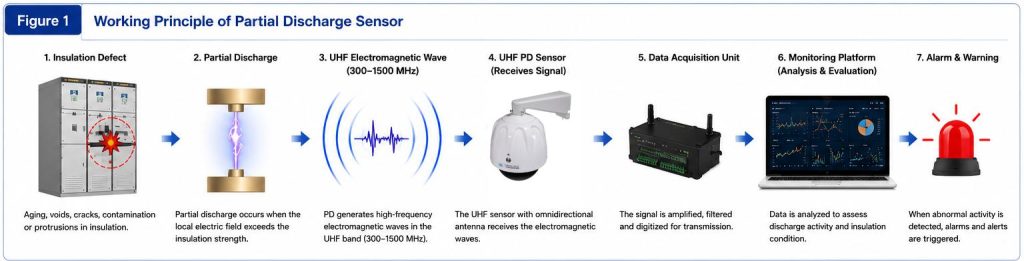
How Does Partial Discharge Occur?
Partial discharge is usually caused by insulation defects such as:
- Air voids
- Cracks
- Surface contamination
- Moisture ingress
- Metallic protrusions
When the local electric field exceeds the dielectric strength of the insulation, a discharge occurs in a small portion of the insulation system.
Although the discharge energy is relatively low, repeated activity can significantly accelerate insulation aging.
Working Principle of UHF Partial Discharge Sensors
Among all PD detection technologies, Ultra High Frequency (UHF) monitoring is one of the most widely used methods.
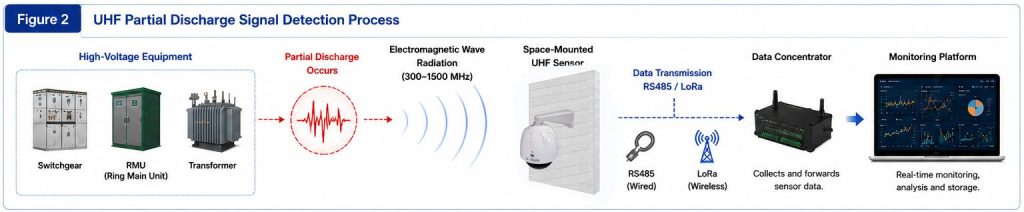
Step 1: PD Generates Electromagnetic Waves
During a partial discharge event, high-frequency electromagnetic waves are emitted.
Typical frequencies range from:
300 MHz to 1500 MHz
These signals can travel through switchgear compartments, substations, and equipment enclosures.
Step 2: UHF Sensor Receives the Signal
A UHF sensor uses a specially designed antenna to capture electromagnetic waves generated by the discharge.
The received signal is converted into electrical data for further processing.
Step 3: Signal Processing
The monitoring system performs:
- Signal amplification
- Noise filtering
- Pattern recognition
- Trend analysis
This helps distinguish actual PD activity from environmental interference.
Step 4: Alarm and Diagnosis
When abnormal discharge activity exceeds predefined thresholds, the monitoring platform generates alerts and maintenance recommendations.
This enables predictive maintenance rather than reactive repairs.
Advantages of UHF PD Sensors
High Sensitivity
Detects weak discharge activity at an early stage.
Excellent Noise Immunity
Less affected by industrial electromagnetic interference.
Online Monitoring Capability
Supports continuous monitoring without equipment shutdown.
Wide Coverage
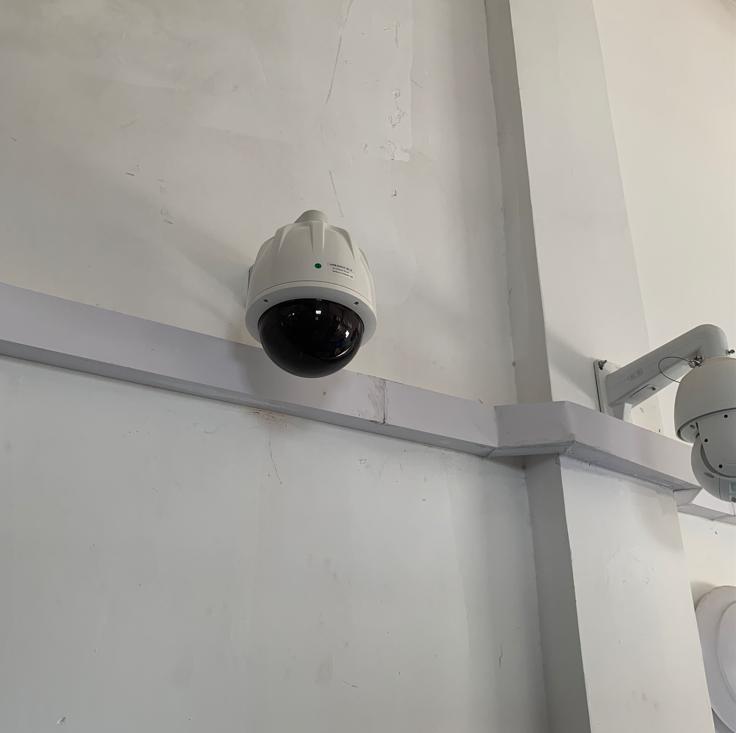
A single space-mounted UHF sensor can monitor multiple pieces of equipment within a room.
Applications of Partial Discharge Sensors
Partial discharge sensors are widely used in:
GIS (Gas Insulated Switchgear)
UHF monitoring is considered the industry standard.
Switchgear
Used for insulation condition assessment.
Ring Main Units (RMU)
Supports continuous monitoring in distribution networks.
Transformer Rooms
Provides early warning of insulation defects.
Cable Systems
Detects discharge activity in cable terminations and joints.
Online Partial Discharge Monitoring Systems

Modern PD monitoring systems typically include:
Sensing Layer
- UHF sensors
- HFCT sensors
- Acoustic sensors
- TEV sensors
Communication Layer
- RS485
- Ethernet
- Fiber optic
- LoRa wireless communication
Platform Layer
- Data acquisition
- Trend analysis
- AI diagnosis
- Alarm management
Application Layer
- Web monitoring platform
- Mobile applications
- SMS and Email notifications
Conclusion
Partial discharge sensors play a critical role in modern electrical asset management.
By detecting electromagnetic, current, acoustic, or voltage signals generated by insulation defects, these sensors provide valuable insights into equipment condition and help prevent unexpected failures.
As utilities continue to adopt predictive maintenance strategies, UHF partial discharge sensors have become one of the most effective technologies for online condition monitoring of GIS, switchgear, RMUs, transformers, and cable systems.